
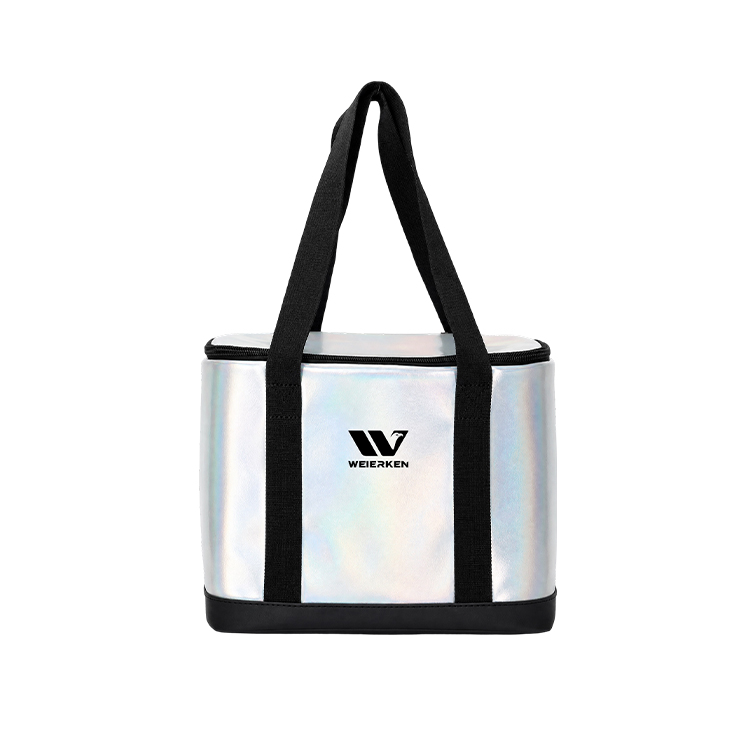
A logo that looks clear in one studio photograph may disappear against a bright patch on an iridescent delivery tote. For a café or takeaway brand, the purchasing question is therefore not just “Can you print our logo?” It is “Will the chosen mark remain recognizable on the finished panel when the bag is carried, filled and viewed from different directions?”
The Weierken DBS044 iridescent insulated delivery tote is a useful starting reference: its product photograph shows a pale iridescent exterior, black webbing, a black base and a dark front logo between the handle runs. That visible arrangement gives a development team something concrete to review. It does not prove a particular print process, material chemistry, color tolerance or durability rating.
Separate the changing background from the fixed brand mark
For an ordinary solid-color tote, the approved body swatch is one main reference. For an effect finish, the background appearance also needs a viewing method. A single photographed blue, pink or silver patch should not become the exact color target for every part of an iridescent panel.
BYK-Gardner’s technical paper on effect finishes explains that appearance can vary with illumination and viewing angle. Its detailed measurement discussion concerns effect coatings; it is background for the review principle, not evidence that DBS044 uses a particular coating or that Weierken has performed a multi-angle laboratory test.
The practical purchasing response is to approve two things separately: the intended range of exterior appearance and the readability of the decoration against it. A finish can have the intended shifting appearance while a thin logo is still difficult to recognize. Conversely, a readable black logo does not establish that the body finish matches the agreed physical reference.
Use the finished panel to choose logo size and position
On the DBS044 reference, the two black handle runs define the usable front branding area. Ask for a marked front-panel drawing showing the logo box, its distance from both webbing edges and its position relative to the zipper and base. Do not calculate print area from the outside bag width alone.
Start with the smallest text and the narrowest stroke in the actual artwork. Review those elements on a physical decorated sample, not only an enlarged screen proof. If the small wording disappears, compare a simplified mark, a larger placement or another proposed decoration treatment. These are alternatives for sampling, not a promise that every artwork file or printing method will work on the proposed exterior.
Check the bag with the handles both standing and hanging naturally. A mark can sit correctly on a flat drawing but be partly covered by loose handles at pickup. Also examine the panel with the intended contents inside: bulging, folds and seams can change how much of the logo is visible.
Make the viewing sequence repeatable
Choose a physical exterior reference and identify the assembled sample revision. Put them in the same viewing area, use the agreed light source and background, and assess them side by side. Record the light source used; “office lighting” without a location or fixture reference is difficult to reproduce during the next sample review.
Begin with a straight-on view, then turn the bag to the left and right while keeping the viewing setup consistent. Include the normal customer handover view and an overhead counter view if those are important to the program. These are practical use checks, not standardized instrumental measurement angles. If a buyer needs numerical color or appearance limits, agree the appropriate method with the material and testing parties before setting acceptance values.
Take a small, labeled photograph set for communication, keeping camera settings consistent where practical. Do not substitute a phone photograph or edited marketing image for the retained physical reference. If the two photographs look different, compare the actual samples under the same setup before deciding that the material batch has changed.
A filled-in development brief for a branded delivery tote
Demonstration only: the following fictional entries show how to brief a sample review. They are not a completed Weierken test, a real customer case or an approved production specification.
| Decision | Illustrative brief entry | Evidence for release |
|---|---|---|
| Starting format | DBS044 reference; retain the front branding area between the black handle runs | Marked panel drawing and the assembled development sample |
| Artwork | Logo file CAF-A02; compare the full wordmark with a simplified mark | Actual-size decorated panels identified by artwork version and proposed application method |
| Appearance review | Compare against physical exterior reference IR-A under the recorded review setup | Side-by-side observations at front, left and right views; retain the reference itself |
| Handling review | Read the mark with handles hanging and with the agreed representative load inside | Loaded sample photographs and a note of any obstruction or fold through the mark |
| Unresolved issue | Hold artwork release if the small descriptor cannot be read in the agreed handover view | Choose a specific revision, then repeat the affected checks on the revised sample |
The aim is a release decision that another person can follow. “Make the logo clearer” is not enough. “Compare a larger simplified mark within the same panel box, then repeat the hanging-handle review” tells the sample team what changes and what remains fixed.
Do not merge appearance approval with wear or insulation approval
Keep visual acceptance, decoration durability and insulated-bag performance as separate lines in the brief. A good-looking sample does not establish rub resistance, cleaning compatibility, thermal retention, water resistance or food-contact suitability. Those questions need their own specified materials, methods and evidence.
Before any cleaning or wear assessment, identify the proposed exterior and logo application. Record the cleaning agent, handling action and assessment method to be reviewed rather than using a vague instruction such as “test waterproof holographic material.” The finish name alone cannot establish those properties. Our custom bag logo wear review covers the separate durability brief, while the swatch-to-sample color approval process covers the wider component reference set.
A fold or surface line should also be documented rather than automatically accepted or rejected. Compare it with the retained approved sample, note its location and review whether it obstructs the mark or indicates a change requiring investigation. Do not invent a universal allowable crease count or cosmetic limit from a product photograph.
Send Weierken an enquiry the development team can use
For custom bag material and branding development, include the starting product reference, vector artwork, intended carrying situation and any fixed brand requirements. Mark the logo areas that cannot change and identify where a simpler mark or contrasting application can be considered. Keep a separate line for quantities and commercial requirements rather than treating a visual direction as a quotation.
Send the DBS044 branding brief to Weierken with the sample and artwork reference numbers. Ask the development review to return the proposed panel placement and application method against that brief. Approval should identify the physical exterior reference, decorated sample revision and any remaining tests—not simply say “iridescent color approved.”
Frequently asked procurement questions
Can we approve an iridescent delivery bag from a photograph?
A photograph can select a visual direction, but it should not be the only bulk-production appearance reference. Retain the identified physical material and decorated sample, record the viewing setup, and review them together. Different capture conditions can make the same finish look different.
Will a dark logo always be readable on this finish?
No universal color choice guarantees readability. The mark’s size, stroke width, background appearance, panel shape and handle position all matter. Compare the actual artwork on the proposed finished panel under the agreed viewing and handling conditions.
Does the iridescent appearance mean the tote is waterproof?
No. Appearance does not establish the exterior’s composition or the bag’s resistance to water ingress. Review material information, seams, zipper construction and any required testing separately. The DBS044 photograph is not a water-resistance certificate.
What should change if the logo is hidden when the bag is carried?
First record what covers it: loose handles, a fold or the packed load. Then revise the panel position, logo size or artwork treatment as appropriate and repeat the same handling check. Keep the old and revised sample references so the change can be traced.
From brief to sample
Build the right bag for your collection.
Share the intended use, product format, quantity and destination market. Weierken can review the construction and sampling requirements with your team.
Discuss your bag project Explore OEM & ODM