
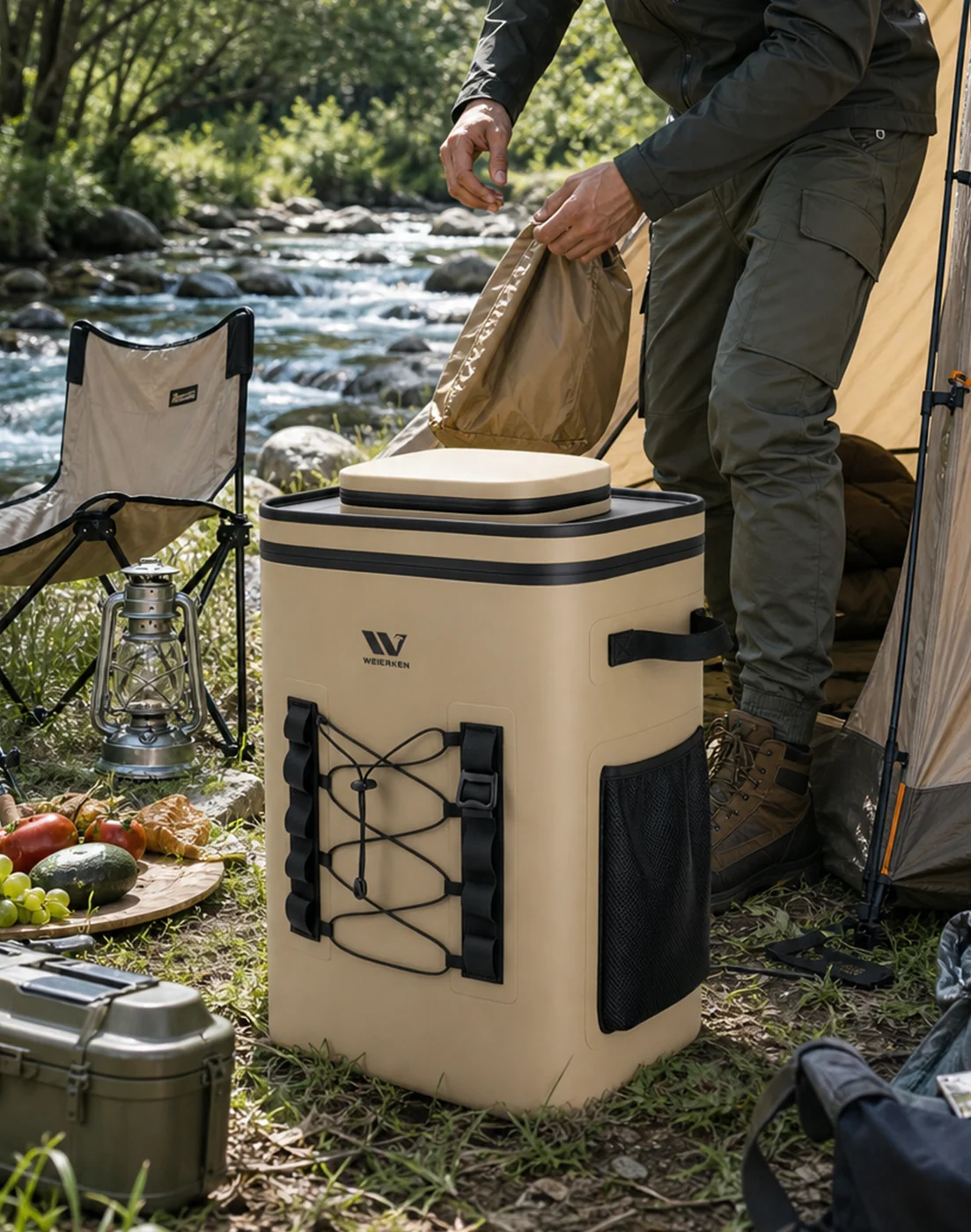
A liter figure does not tell your customer whether a lunch box will pass through the opening or fit beside the cooling packs. For a Weierken custom cooler bag, start with the actual packed load. Capacity, insulation, liner and opening can then be developed as one design instead of enlarging the outside of a bag that still does not fit its contents.
Use the container dimensions, not just a capacity target
The example below is fictional and demonstrates a briefing method. It is not a specification or verified capacity for a Weierken product. Measure containers at their widest points, including lids, handles and any wrapping that remains during use.
| Item | Quantity | Illustrative outside size | Packing instruction |
|---|---|---|---|
| Lunch container | 2 | 180 × 120 × 65 mm each | Stack upright; remove the upper one without tilting it. |
| Drink bottle | 2 | 70 mm diameter × 230 mm high each | Stand upright beside the containers. |
| Cooling pack | 2 | 160 × 100 × 20 mm each | Reserve a position on each side; include them in the fit trial. |
| Cutlery pouch | 1 | 180 × 60 × 30 mm | Keep accessible without moving the cooling packs. |
Do not add the rectangular item volumes and present the result as the required bag capacity. Arrangement, gaps, curved corners, dividers and access clearance affect whether the load fits. A drawing or a photographed arrangement is more useful than a total alone.
Review three different dimensions
- External size: useful for shelf, vehicle or packing limits. State the bag’s condition when measured.
- Usable interior: check the finished sample with the actual liner and insulation, not the unlined shell.
- Clear opening: confirm the largest container can pass through without forcing the closure or distorting the bag.
Weierken’s capacity and construction customization can connect the intended load to dimensions, compartments and opening design. Send the load schedule together with your external size limit; those two requirements may conflict, and the development review should make the trade-off visible.
Approve a loading plan that can be repeated
Photograph the empty interior, the complete item set and the closed loaded bag. Number removable dividers and show where the cooling packs go. If the sample only closes after one intended item is removed, record a failed fit for that arrangement rather than approving the nominal liters.
For multiple sizes, create a separate load plan for each. Do not extrapolate usable capacity from a scaled image. Before finalizing, check the divider layout and the closure review against the same packed condition.
Send Weierken your largest container dimensions and a photo of the normal load through the project inquiry form. Include any non-negotiable outside-size limit so the first proposal addresses both fit and handling.
Frequently Asked Questions
Should we brief two cooler sizes together or separately?
Send one range overview but a separate load schedule and size limit for each bag. Identify shared styling or components without assuming one size’s fit review approves the other.
What if the bag must fit both a retail shelf and a packed delivery carton?
List those as separate constraints and identify the condition in which each is measured. Have Weierken review the bag and packing proposal together before committing to external dimensions.
From brief to sample
Build the right bag for your collection.
Share the intended use, product format, quantity and destination market. Weierken can review the construction and sampling requirements with your team.
Discuss your bag project Explore OEM & ODM