
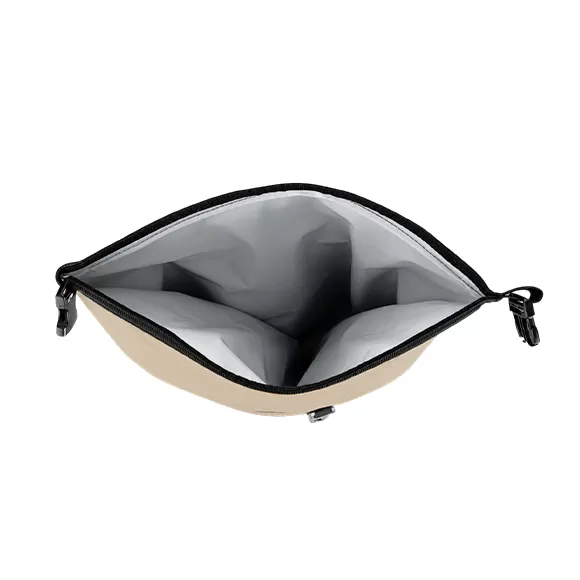
“Make this ODM cooler bag a little larger” sounds like a small instruction. In practice, a size change can affect the opening, insulation layout, liner fit, carrying position and packing. The visible outline is only one part of the construction. Approving a new litre figure without reviewing these dependencies leaves important decisions unresolved.
This guide focuses on size adaptation of an existing cooler platform. It complements our OEM and ODM overview by showing how to write a specific change request. The examples are illustrative engineering discussion tools, not approved drawings, capacity calculations, test results or quotations.
Define what needs to fit before changing dimensions
Begin with the items the buyer wants to carry. List container dimensions, quantities, coolant placement and the loading sequence. Explain what does not work in the reference model: a lunch box catches at the opening, a bottle pushes against the lid, or the cooling pack uses space needed for the food load. These are different design problems.
State whether a dimension is internal usable space or an external measurement. Insulation, seam allowance and the opening structure mean the two should not be treated as interchangeable. A bag with a wider exterior may still fail to accept the desired container if the opening narrows above the liner.
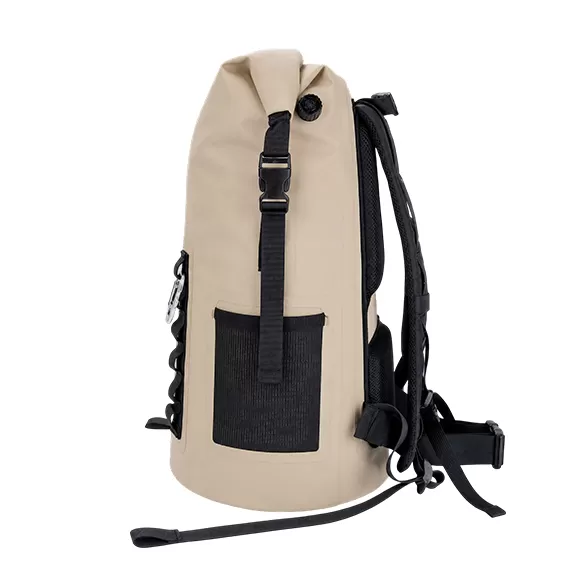
The cooler bag capacity guide helps define the load. A catalogue reference such as the C18-26SS roll-top cooler backpack also makes the starting platform clear. Do not infer the performance of a new size from that reference alone.
A worked size-change impact matrix
Illustrative request: the buyer wants room for an additional food container while keeping the carry method and general style. Instead of prescribing an arbitrary new capacity, the buyer supplies the container and loading reference. The factory is asked to review the following connected parts before a final sample is ordered.
| Area | What the request may affect | What to compare on the revised sample |
|---|---|---|
| Opening and lid | Entry clearance, closure path and lid coverage | Load the actual container set without forcing the opening |
| Liner | Panel shape, corner fit and usable room | Check corners, access and the loaded condition |
| Insulation | Panel coverage and compressed areas at joins | Review the build-up and agree whether new performance evidence is needed |
| Straps and anchors | Carry position, adjustment and loaded balance | Assess fit with the specified load, not only an empty bag |
| External pocket | Clearance around the changed body and closure | Open the pocket and main compartment in the intended use sequence |
| Base and support | Standing footprint and support arrangement | Check stability and how a support insert is fitted or removed |
| Packaging | Folded size, shape recovery and carton loading | Pack a finished sample using the proposed packing method |
The matrix is not a demand that every part must change. It is a list of dependencies to review. The supplier may explain that one component can remain unchanged, but that explanation should be tied to the revised construction rather than assumed from the previous model.
Review an actual loading sequence, not just a larger outline
When the prototype arrives, recreate the intended routine. Place coolant where the brief specifies, add the containers in the planned order, close the bag correctly and try the normal carrying method. Record where the user needs to rearrange, compress or remove items to make the bag work.
A useful comment is specific: “The top container catches under the front closure when both cooling packs are installed.” A vague comment such as “capacity still too small” does not identify whether the problem is the opening, liner, load arrangement or overall dimensions. Annotated photographs and a short loading video can communicate the difference.
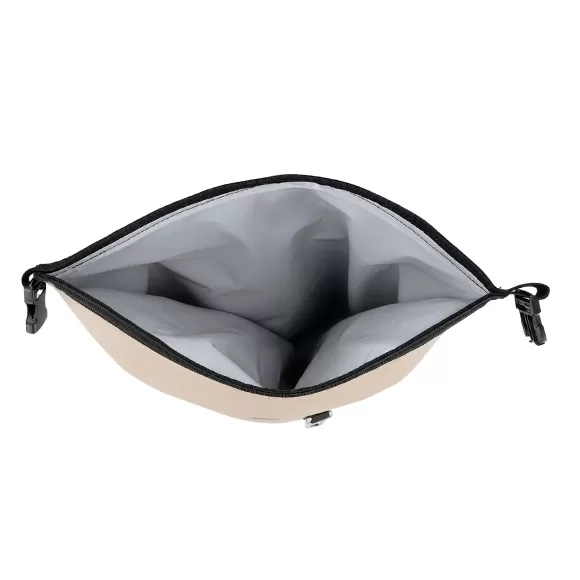
For a roll-top construction, do not count unclosed headspace as usable carrying volume. Preserve the intended closure method. For a lid-style bag, check the lid with the actual packed load rather than judging its overlap while the bag is empty. These are construction reviews, not proof of waterproof or insulation performance.
Recheck cost and packing after the design changes
Ask which quotation assumptions were affected. More fabric is only one possibility. A change may alter the pattern layout, trim length, support panel, assembly work or packing volume. Conversely, a carefully chosen dimension may preserve some existing components. The response should explain the actual proposal instead of applying an unexplained percentage increase.
| Line to review | Question for the revised proposal |
|---|---|
| Materials | Which material codes and quantities changed, and which stayed the same? |
| Development | Does the request need a revised pattern, another prototype or additional review? |
| Production | Which operations are affected by the new construction? |
| Packing | Is the quoted carton plan based on an actual packed sample or an estimate? |
| Performance | Which existing evidence still applies, and which questions remain open? |
Use the carton planning guide when discussing packing and freight assumptions. Do not calculate shipping from external bag dimensions alone. A proposed fold may reduce space but also change the bag’s appearance after unpacking, so include shape recovery in the sample review.
Freeze the revised drawing, sample and material list together
Give the revised version a clear identifier. Record the starting model, requested changes, decisions accepted and points still open. Link the new drawing, bill of materials, artwork and reference sample to the same revision. Do not approve the new sample while leaving an old dimensional sheet in circulation.
Where a change affects a performance claim, refer it to the responsible reviewer. A new size should not inherit a previous cooling-time statement simply because the outer fabric stayed the same. Our insulation test brief explains how to keep configuration and test evidence connected.
Weierken’s customisation capabilities provide a starting point for discussing materials, dimensions and construction. Send the intended loading reference and this change list, then ask which adaptations fit an existing platform and which need further development. Timing and commercial terms should follow that review, not a generic ODM label.
Frequently asked questions
Can we increase capacity while keeping every component unchanged?
Do not assume so. Ask the factory to identify which components remain suitable and which need review. Closure clearance, carrying balance and the packing plan can change even when the visual style remains familiar.
Should we send a target litre figure or container dimensions?
Provide both if available, but distinguish the catalogue target from the usable load requirement. Container dimensions and a loading reference help the team evaluate access and internal space.
Does a larger sample need a new insulation test?
That depends on the change and the claim being made. Ask the responsible reviewer which existing evidence covers the final configuration and what further verification is needed.
Send Weierken your reference model, loading photographs and proposed size changes to start a project-specific feasibility discussion.
From brief to sample
Build the right bag for your collection.
Share the intended use, product format, quantity and destination market. Weierken can review the construction and sampling requirements with your team.
Discuss your bag project Explore OEM & ODM