
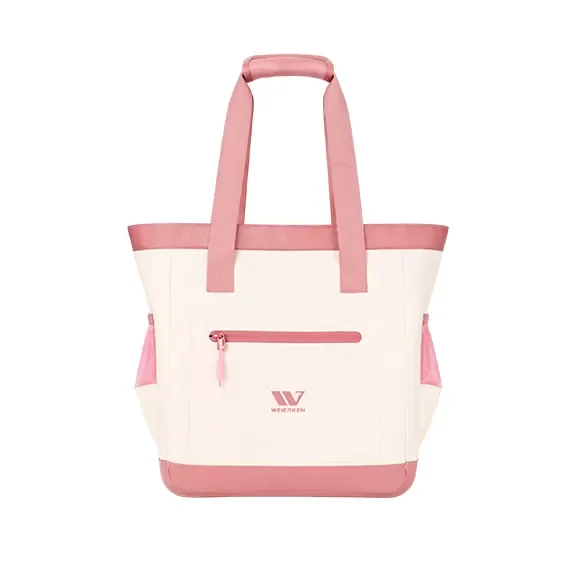
A private label bag hangtag attachment approval should cover the tag on the physical bag sample as well as the artwork file. Define the intended attachment point, fastener, tag size and packed retail view. Check whether the tag obstructs a pocket, catches a closure or conceals the part of the bag the retailer needs to show. Keep the approved arrangement linked to the product and packaging revision. This provides a practical procurement reference while leaving permanent labeling obligations and destination market requirements to the appropriate product compliance review for the actual order.
A finished retail bag can be correctly branded and still reach the shop with a hangtag that hides the main logo, catches in a zipper or rubs against a light-colored panel. Tag approval should therefore include the attachment and packed arrangement, not only the artwork file.
For a Weierken private-label bag project, treat the hangtag as a removable component in the packing specification. Decide where it belongs, how it is attached and what must happen when the buyer unpacks the product. This review is separate from permanent product labeling and any destination-market requirements.
Choose the attachment point on the actual sample
Start with the intended retail view. Mark which side should face the customer and which brand elements must remain visible. Place a physical paper mock-up at the proposed location. Check it with handles upright, laid down and in the packing position rather than judging it only from a flat artwork proof.
Avery’s swing-tag overview describes removable tags as a way to present product and brand information. The tag’s communication role does not resolve its attachment on a particular bag. That requires a product-specific physical review, which is the focus of this guide.
Specify the fastener without damaging the construction
Describe the proposed cord or loop, the attachment route and the finished free length. Identify any surface that it may contact. Do not instruct packing staff to pierce a coated panel or liner with a tagging tool simply because that is a familiar method for another product type.
Where an existing handle or approved loop is suitable, show the exact route in a photograph. If no location works, raise a design question before production. A new loop is a construction change, not something to improvise during packing. The decision belongs with the approved bag specification and the sample revision record.

Review access and surface contact
Operate the adjacent zipper and open the main compartment with the mock-up fitted. Check whether the tag enters the slider path, blocks a pocket or becomes trapped when the handles are folded. Review the presentation again with the product in its retail wrap, if one is specified.
For printed tags against coated or pale surfaces, define a relevant contact review with the responsible teams. Inspect the actual approved materials under the agreed conditions; do not promise that all inks, cords or coatings are compatible. Retain photographs of the contact position and observations so a changed tag stock can be evaluated against the same arrangement.
A filled attachment approval card
These are fictional worksheet entries, not an approved attachment method or completed test for B01.
| Decision | Illustrative entry | Evidence retained |
|---|---|---|
| Display side | Keep the front brand mark visible when the handles stand upright | Front-view placement photo |
| Attachment route | Review an existing approved handle loop; no panel puncture | Close-up of the complete cord route |
| Functional clearance | Tag and cord stay outside the adjacent zipper path | Open/close sequence with the physical mock-up |
| Packing position | Tag remains readable without pressing its edge into the panel | Approved wrapped sample and orientation photo |
Match artwork, SKU and placement versions
Identify the tag artwork version, product model, color variant, language version and attachment photo on one approval record. A correct barcode on the wrong color variant is still a packing error. Keep tag-to-product identification distinct from the separate carton and packaging specification.
When a retailer supplies replacement artwork, review both its information and physical dimensions. A larger tag can interfere with a pocket even if its graphics are correct. A new fastening loop can change its resting position. Do not silently preserve the old attachment photograph after changing either component.
Make the packing check observable
Give the packing team a marked photo of correct orientation and a short list of unacceptable arrangements: wrong side facing out, tag trapped in a zipper, unapproved puncture or mismatched model information. Check these against the agreed sample and inspection scope rather than accepting “tag attached” as a complete instruction.
For a reorder, retain the original approved card and compare the new materials with it. If a problem is found, identify the affected model or packing group and record the disposition. The quality issue photo checklist can help organize the evidence without treating every visible mark as proof of its cause.

Who this development brief is for
Best for: brand sourcing teams, distributors and product developers preparing an OEM sample review. Suitable for: a defined industrial or commercial bag project with an identified approval owner. Not suitable for: inferring a load rating, protection claim or universal compatibility from a reference photograph alone. Record the required order quantity, destination, packaging and delivery objective in the RFQ.
Procurement FAQ
Can a hangtag be attached through the bag panel?
Do not assume that puncturing the panel is acceptable. Use the approved construction and attachment specification; coated or lined products may require a different solution. Ask the supplier to identify the intended attachment route on the sample photograph or drawing. Review any possible effect on the panel, lining, closure or surface finish before approving it. Keep that decision with the fastener and product revision rather than treating a convenient attachment as automatically acceptable.
Is artwork approval enough to release the tag?
No. Approve the physical size, attachment route, placement and packed presentation as well. Artwork alone cannot show interference with a zipper or pocket. Use the approved bag sample to check the tag in the intended retail and packed positions. Record the fastener and the artwork revision in the same approval package. If the tag format changes, revisit any clearance or presentation observation affected by the change before production packing begins.
Can one attachment photo cover every color and size?
Only where the approved arrangement genuinely applies to those variants. Record any different handle, pocket or packing geometry instead of concealing it under one generic photo. Identify which variants share the approved arrangement and which require their own placement reference. Keep the SKU and artwork information legible in the inspection record. A packing team should be able to match the physical tag to the correct bag without guessing from a photograph of another version.
What should we send to start a private-label tag review?
Provide the product reference, intended retail view, tag artwork and dimensions, proposed fastener, variant list and packing requirements. Include quantity and destination market for the wider project discussion. Specify the person authorized to approve the tag arrangement and distinguish mandatory placement requirements from preferences. Ask the supplier to return any assumption about the fastener or packing method. Resolve those details against a physical sample before treating the quotation as an approved production packing specification.
How should tag changes be controlled for repeat orders?
Link the approved artwork, tag dimensions, fastener and placement photograph to the product and packaging revision. Identify the variants to which that arrangement applies. When a handle, pocket, tag format or packing method changes, review the affected clearances and retail presentation again. Keep the resulting approval with the order so that a previous photograph is not silently reused for a different arrangement.
Approve the whole retail presentation
Explore Weierken’s bag formats and send your private-label packing brief. Weierken can review the tag arrangement with the bag sample; applicable labeling advice, test scope, MOQ, price and delivery commitments remain specific to the order.
From brief to sample
Build the right bag for your collection.
Share the intended use, product format, quantity and destination market. Weierken can review the construction and sampling requirements with your team.
Discuss your bag project Explore OEM & ODM