
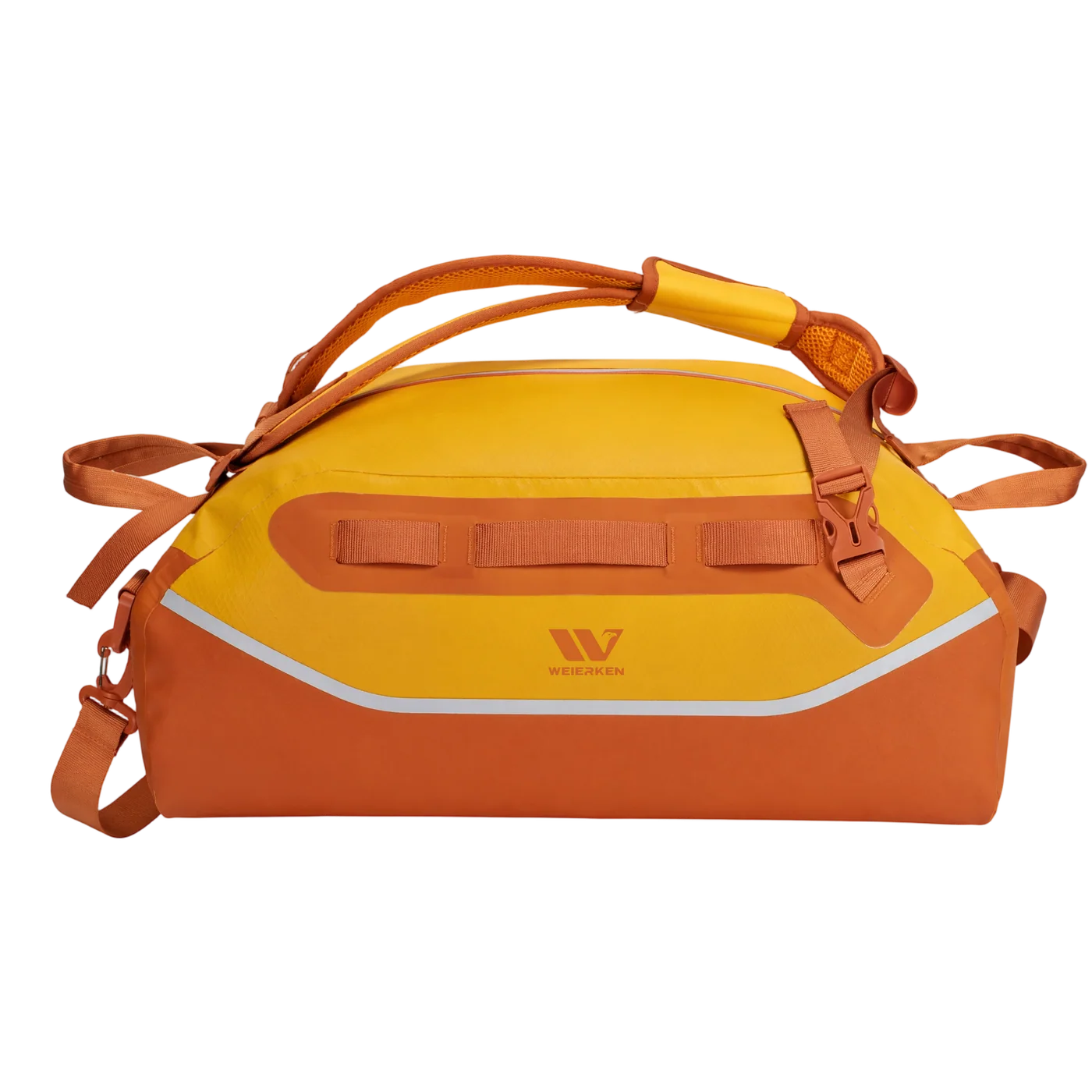
A waterproof travel duffel can offer several carrying methods while still leaving one small but important interaction unresolved: where the zipper slider finishes, and whether the user can reach it without moving a strap. This review is about that interface, not about fitting the largest possible object through the opening.
Draw the closing route and the final position
For a custom duffel, mark the zipper start, travel direction and final parked position on a drawing. Identify the actual zipper component and its closing instructions. Different waterproof closure systems have different end details; a general photograph cannot establish that a slider is fully closed.
Weierken’s W16 multi-carry travel duffel combines a wide opening, handles, backpack straps and shoulder carry points. It is a useful platform for discussing clearance between closure and carrying components. The catalog model name does not establish a test result for a new customized bag. Any protection claim must match the exact approved construction and evidence.
Check the bag in every intended carrying configuration
Lay the unused straps where users are expected to keep them, rather than moving them out of frame. Open and close the bag in hand-carry, shoulder-carry and backpack configurations if those modes are included in the project. Watch whether the slider pull catches a loose strap tail or whether hardware rests across the zipper end.
Repeat with the bag packed. A rigid object near the top may change the panel shape and make the final closing movement less accessible. If a user must push down the contents, rotate the bag or remove a shoulder strap, record that action. Decide whether to change the packing limit, strap routing or construction.
Do not pull harder to conceal interference during the demonstration. Show the actual obstruction and request a revised arrangement.
Use a closing-path check sheet
The entries below are illustrative inspection prompts, not completed tests or universal acceptance limits.
| Review position | Action | Evidence to retain |
|---|---|---|
| Empty bag on a table | Move the slider through its complete specified travel | Close-up of the actual final position |
| Normal packed load | Close without rearranging the uppermost contents | Video of any panel distortion or contact |
| Backpack straps unused | Place straps in their intended stowed arrangement | Photo showing whether loose tails enter the closing path |
| Shoulder strap fitted | Reach the zipper end with the strap and hooks installed | Marked image of any hardware interference |
Record the sample revision and the zipper reference with the sheet. A later component substitution may change the slider dimensions or operating action even if the zipper length is unchanged.
Separate closure care from appearance approval
Obtain care instructions for the specified zipper and reproduce only what applies to that component. Do not recommend a generic lubricant, cleaning chemical or maintenance interval borrowed from another closure. Ask how contamination should be removed and what users should check before closing.
If instructions require a particular final movement, make that visible in the user guide. A decorative pull extension must not make the closed position ambiguous. Product photographs should show the approved parked position rather than a partly closed zipper arranged for styling.
Keep water protection and usability evidence separate
A smooth operating demonstration does not establish water protection. If the project requires a particular exposure claim, agree the relevant method, conditioning, construction and acceptance criteria separately. A sample that was revised to move a strap attachment should be reviewed for the consequences of that change before an old claim is reused.
Our waterproof zipper specification guide covers the wider component brief. Use this closing-path review to add the missing interaction evidence: the actual zipper end, the actual straps and the actual packed shape.
For a quotation request, send the marked drawing, representative load photos, intended carry modes and the destination market. Explain which features are essential and which can change. That gives Weierken a concrete layout problem to assess instead of an unsupported instruction to make every part “more waterproof.”
Procurement FAQ
Can a longer zipper solve poor slider access?
Not necessarily. The problem may be strap placement, panel shape or the zipper’s final closing action. Review those together before changing the length, because a longer opening can affect the rest of the construction.
Should unused straps be removed before checking the closure?
Only if removal is part of the intended user instructions. Otherwise review the bag with the straps present in the planned stowed position so interference is not hidden.
Does this check verify an IP rating?
No. It checks access and interference. A protection claim requires appropriate evidence for the specific finished construction; neither a model name nor a successful zipper movement establishes that result.
Discuss your project with Weierken
Send Weierken a sketch of the zipper end and your intended strap arrangement to review the custom duffel’s closing path. Send your project brief with the intended quantity, market and reference files. Pricing, sampling, MOQ and delivery commitments are confirmed for the agreed specification, not assumed from this guide.
From brief to sample
Build the right bag for your collection.
Share the intended use, product format, quantity and destination market. Weierken can review the construction and sampling requirements with your team.
Discuss your bag project Explore OEM & ODM