
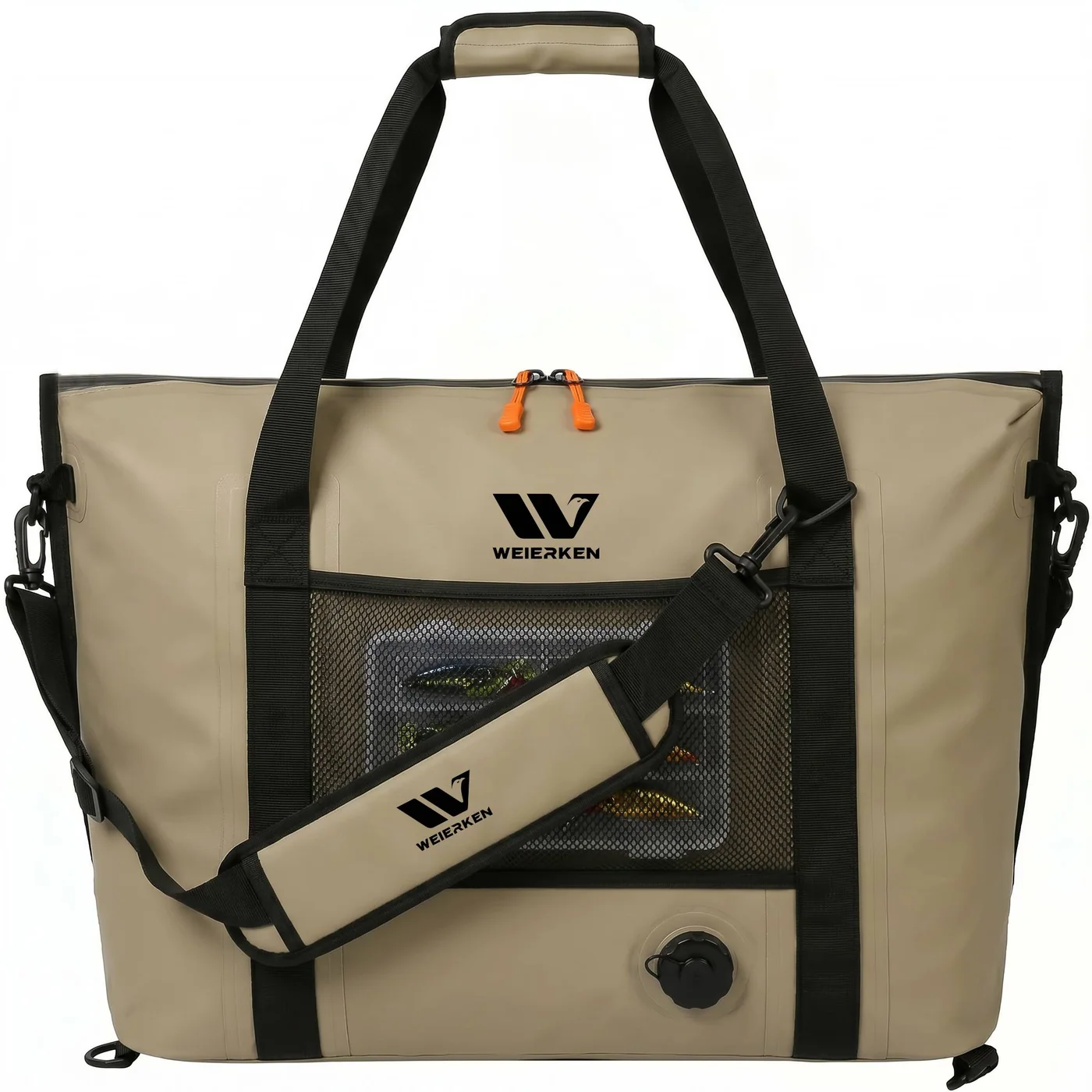
A cooler bag drain valve should be specified as part of the complete lower-body construction, not as an isolated accessory. Buyers need to check where water collects, whether the cap can be reached with the bag loaded, and how the valve is cleaned and resealed. A low-looking position in a front photograph does not establish complete drainage or leak resistance.
For an OEM cooler bag project, Weierken can use a product such as the C20-26SS fishing cooler with drain valve as a starting reference. Its listed body material is 500D PVC and its valve supports draining after use. That does not establish the valve specification, test result or material choice for another model. Those details belong in the new project’s sample review.
1. Draw the path from the liner floor to the outlet
Start with the bag standing on the surface where the user expects to empty it. Mark the liner floor, any raised edge, internal reinforcement and the outlet entry. Water may remain behind a folded liner corner even when the external valve sits close to the base. Conversely, placing an outlet too close to a supporting surface can make the cap awkward to turn.
Ask for a section drawing showing the liner-to-valve interface and the outer-body support. Identify which part is intended to seal and which part only reinforces the opening. This is different from selecting fabric thickness: a suitable body material cannot compensate for a poorly defined connection. Read the cooler bag liner design guide alongside the valve drawing.
2. Use a review record that leads to a decision
The following is an illustrative procurement worksheet, not a completed Weierken test or customer case. It shows how a comment can become an actionable sample instruction without inventing a universal acceptable drain time.
| Review point | Example observation to record | Next decision |
|---|---|---|
| Outlet entry | A small pool remains behind the rear liner fold when the bag is upright | Photograph the remaining pool; review the fold and agreed emptying position |
| Cap access | The filled side panel presses against the user’s fingers | Check cap clearance under the intended load before moving the outlet |
| Outlet support | The outer panel distorts while the cap is turned | Review the support patch and assembly sequence with the factory |
| Resealing | The user cannot tell whether the cap is fully seated | Agree operating instructions and inspect the closed assembly |
Keep the sample identifier and drawing revision on this record. Otherwise, the inspector may be assessing a revised outlet against photographs of an earlier liner. A useful decision is specific: retain the outlet, change the liner fold and repeat the review. “Improve drainage” leaves too many variables open.
3. Check access with straps, pockets and the packed load
Operate the valve with the actual bag loaded, rather than only with an empty shell. Put the detachable shoulder strap in its expected position and check whether a loose end covers the cap. If the valve faces a vehicle wall, a large finger grip may still be unusable. Record both the clearance needed to rotate the cap and the direction in which liquid exits.
Review deliberate and accidental contact separately. A cap that is easy to operate may also be exposed to knocks while the bag is carried. Tethers, guards or alternative positions are design options to discuss, not features that every Weierken model already includes. Adding them may affect the pattern, support patch and packing method.
4. Separate drainage, closure sealing and care instructions
A drainage review asks how readily the bag empties in the agreed position. A sealing review asks whether the closed valve assembly performs under an agreed exposure and loading condition. A care review asks how the user reaches and dries the relevant surfaces. Passing one does not answer the others. Record the condition, duration, sample count and observation method before making a claim.
Use model-specific care instructions approved for the finished materials. Do not assume that a cooler can be machine washed, that every cap should be removed, or that the same cleaning agent suits all coatings and seals. If a replacement cap is part of the program, identify its mating parts and revision rather than ordering a visually similar accessory.
5. Freeze the assembly before bulk production
The approved file should contain the valve supplier or part identifier, assembly drawing, liner revision, operating instruction and agreed inspection points. Include photographs of the outlet inside and outside the bag. If the component changes after approval, reassess the mating interface and support instead of treating it as a cosmetic substitution.
For receiving and inspection, connect this record to the finished bag inspection checklist and material and component traceability record. The buyer should be able to identify the affected production lot if a cap or seal concern appears later.
Frequently asked questions
Does a drain valve prove that the entire cooler bag is leakproof?
No. The valve, liner seams and main closure are different potential paths. Agree the finished-product exposure and inspection conditions; do not turn the presence of a valve into a whole-bag performance claim.
Can the same valve be used on every size in a cooler collection?
Possibly, but review the liner depth, supporting panel, cap access and intended load for each size. Component sharing is useful only when the complete interfaces remain suitable.
What should I send before asking Weierken to add a valve?
Send the bag drawing, intended contents, emptying position, preferred outlet side and any care requirements. Include a reference valve if you have one, clearly marked as a reference rather than an approved part.
Send a focused project brief
Send your liner layout and an annotated image showing the proposed outlet position. We can review the construction questions before a valve is added to a sample. Request a Weierken manufacturing review with your company, product format, quantity, destination market and drawings. MOQ, sampling arrangements, pricing and delivery timing must be confirmed for the actual specification.
From brief to sample
Build the right bag for your collection.
Share the intended use, product format, quantity and destination market. Weierken can review the construction and sampling requirements with your team.
Discuss your bag project Explore OEM & ODM