
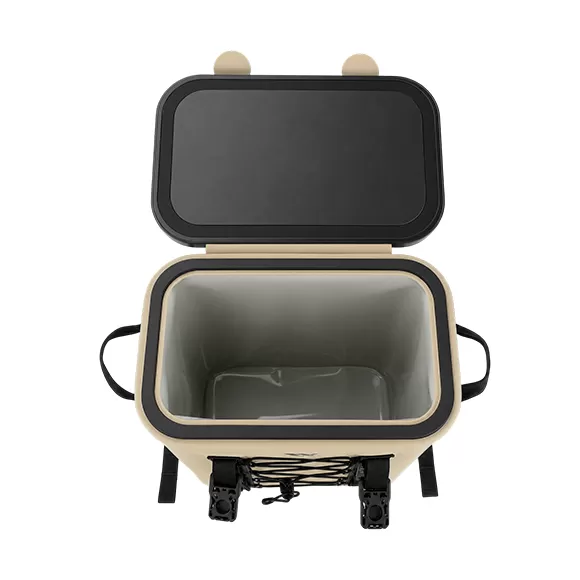
An ice pack pocket changes more than the appearance of a cooler bag interior. It occupies space, adds weight at a particular location and can affect how containers are loaded. Before specifying several pockets, give Weierken the cooling pack dimensions and the real container layout. The right arrangement should be reviewed as a loaded bag, not as an empty drawing.
Specify the pack itself
List the length, width, thickness and mass of the pack in its intended condition. Identify whether the buyer supplies it or it is part of the bag project. A pocket drawn around an approximate rectangular shape may not accommodate a filled, rounded or rigid pack.
State whether users must remove the pack while the bag is partly loaded. This affects opening clearance, pocket direction and attachment. If several cooling-pack sizes are permitted, identify the intended range instead of expecting one pocket to hold any shape securely.
Compare locations around the actual containers
Lay out the containers first, then compare side, lid and divider locations. Check whether a pack blocks a bottle neck, presses on a food-container lid or prevents the main closure from seating correctly. A space that appears unused in an empty sample may be essential during loading.
Do not assume that adding a pocket in a particular location guarantees a longer cooling duration. Compare the complete loading arrangement under the agreed temperature test. The bag, cooling medium, contents and opening routine belong in that review.
Review retention and cleaning together
Examine how the pack stays in place when the bag is carried, tilted or opened. If an elastic edge or fastening is proposed, check insertion with cold or wet hands and make sure it does not interfere with nearby containers. Agree the intended handling rather than inventing a universal retention force.
Inspect the pocket corners and the space behind it. Confirm whether the pocket can be lifted, removed or wiped in place. A compartment that holds a pack securely but traps spills may be unsuitable for the planned cleaning routine.
Approve a loading record that can be repeated
Photograph the container set with the exact packs installed. Record which pack belongs in each location and the usable space left for food or drinks. Review carrying balance with the intended load, not just the empty bag’s listed capacity.
If the pocket is revised after sampling, update its dimensions and attachment drawing. Keep the temperature-test record linked to the loading version; otherwise a later capacity or pocket change can invalidate a comparison with the earlier sample.
Purchasing worksheet
Use this as a project worksheet, not a completed test report. Swipe the table on a small screen.
| Check | Input | Sample record |
|---|---|---|
| Pocket fit | Pack size, shape and mass | Insertion and removal photo |
| Container access | Actual packed containers | Loaded opening clearance |
| Cleaning | Proposed cleaning routine | Pocket corners and attachment access |
Buyer FAQs
Should every cooler bag have an ice pack pocket?
Not necessarily. Loose packs, sleeves and dedicated pockets should be compared against the loading and cleaning requirements of the project.
Does a pocket position establish a cooling claim?
No. Verify the complete bag and loading arrangement using a defined temperature-performance method.
Explore our cooler bag collection alongside the project worksheet below.
Prepare your Weierken project brief
Send pack and container dimensions, the intended arrangement, quantity and cleaning expectations. Weierken can review the pocket as part of the full interior specification.
Related guidance: container fit, interior dividers. Send your project details to Weierken.
From brief to sample
Build the right bag for your collection.
Share the intended use, product format, quantity and destination market. Weierken can review the construction and sampling requirements with your team.
Discuss your bag project Explore OEM & ODM