
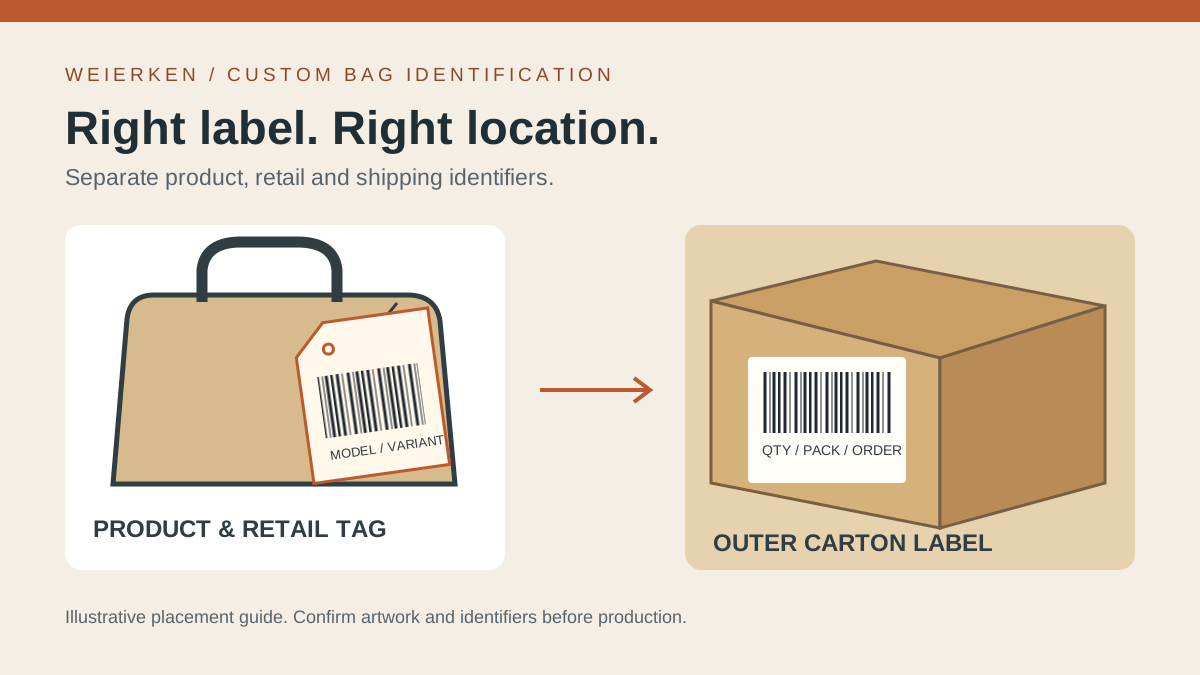
Custom bags may need a sewn product label, a removable retail barcode and an outer-carton label. These serve different workflows. If they are treated as a single artwork item, the wrong code can appear on the right product or a correctly printed label can become difficult to scan after packing.
Give each label a defined owner and purpose
The buyer should supply or approve the identifiers required by its sales and warehouse systems. Do not ask the factory to invent a globally assigned product number. Identify who provides the code, who verifies the encoded data and who approves the final printed layout. Weierken’s production brief can then link those approved files to the relevant model, color, size and packaging version.
Swipe the comparison table horizontally on a small screen.
| Label layer | Typical review question |
|---|---|
| Product identity | Which model or variant is this, and must the identification remain on the bag? |
| Retail packaging | Does the approved sales code match the packed variant? |
| Shipping carton | Does the carton label match its actual contents and packing list? |
The exact fields depend on the buyer’s channel. A marketplace, retailer or distributor may have its own current rules. Obtain those rules directly from the channel and attach the applicable version to the order. This article does not replace a retailer’s labeling specification.
Approve placement on the packed sample
A flat artwork proof cannot show every placement problem. Check whether the label crosses a fold, sits over textured fabric, is covered by a handle or becomes hidden by the retail wrap. Confirm the adhesive and removal requirements for a removable label on the chosen surface. For a sewn label, review the seam location, readable area and any interference with the liner or pocket.
Record a placement drawing or annotated photo with the label dimensions, orientation and distance from a repeatable reference. Include a packed-sample image. A request such as “place the barcode at the back” leaves too much room for variation between production and packing teams.
Use a variant-to-file release table
An illustrative table should contain model, color, size, approved identifier, artwork filename, revision, label location and carton quantity. Use one row per sellable variant. Before release, compare the encoded data with the row and the actual sample. Agree who checks the first packed units and how a mismatch is contained. Scanning with one phone is not proof of compliance with every retailer’s barcode-quality requirement.
Buyer FAQs
Can the same barcode be used across all bag colors?
Follow the buyer’s product-identification rules. If colors are separate sellable variants, obtain the appropriate approved code for each rather than assuming they share one.
Should we send the code as text or finished artwork?
Provide the approved identifier and the required artwork or channel specification, with a named verifier. Confirm that the encoded value and human-readable text match.
Related: packing specification and reorder control. Share your labeling requirements with the model and variant list.
From brief to sample
Build the right bag for your collection.
Share the intended use, product format, quantity and destination market. Weierken can review the construction and sampling requirements with your team.
Discuss your bag project Explore OEM & ODM