
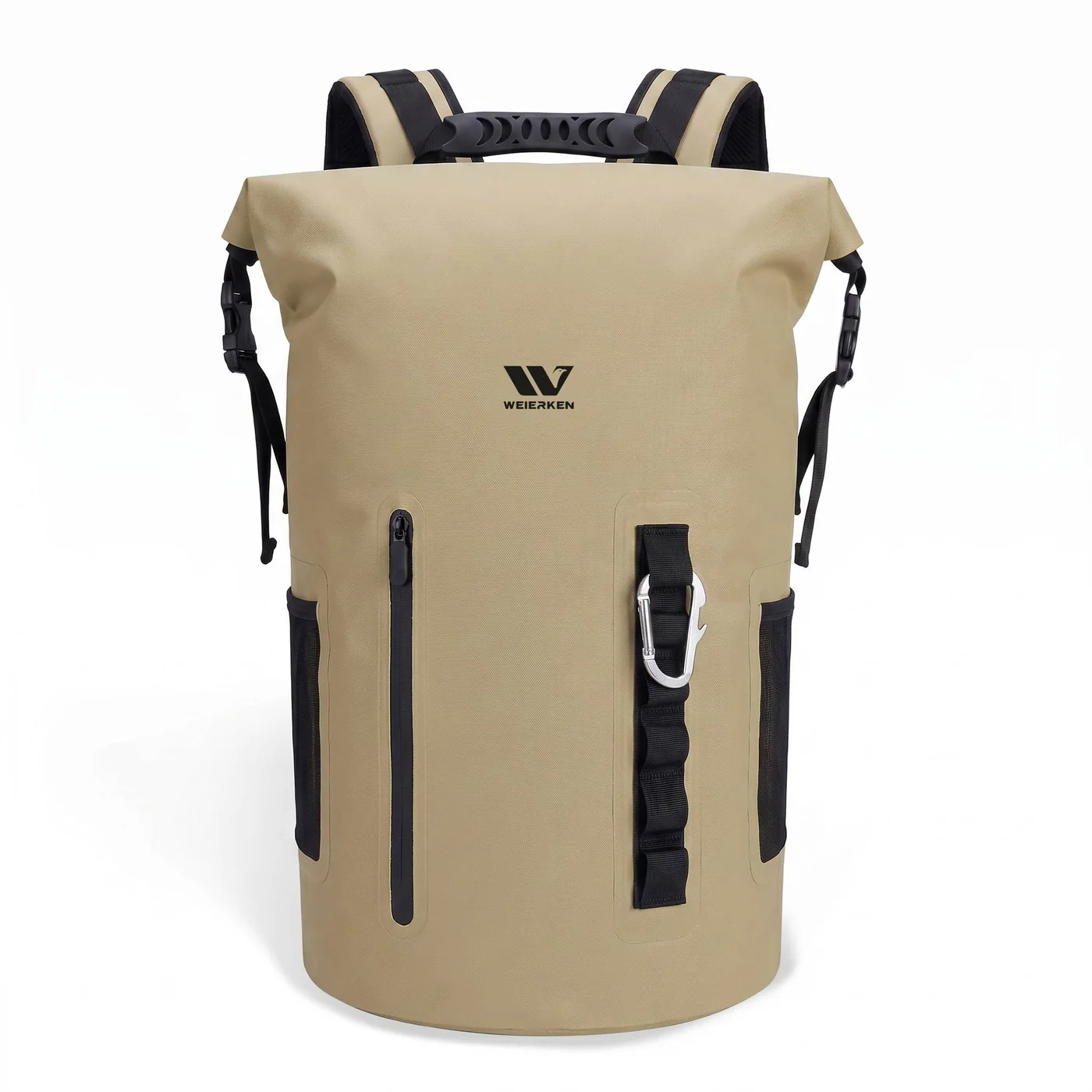
A roll-top bag is not usefully full if it can no longer close as designed. For a Weierken custom waterproof bag, agree the load and closing method together. The usable space below the closure, the open bag dimensions and the closed packed shape answer different purchasing questions; one nominal liter figure cannot replace all three.
Reserve the closing area before approving capacity
Begin with the intended item set and show the area needed for the selected closing procedure. Do not borrow a roll count or allowance from a different design. Have the proposed procedure identified for the actual sample, including buckle arrangement and the load condition under which it is reviewed.
If a jacket fits only by filling the entire top section, record that as an unresolved load requirement. Do not photograph the open overfilled bag as proof that the complete kit fits in normal use.
A filled three-state capacity review
Illustrative review for a day-trip bag concept; it does not establish dimensions, closing instructions or performance for a Weierken catalogue model.
| State | Example contents | What to record | Decision |
|---|---|---|---|
| Empty and open | No load | Body dimensions, opening and identified closing zone | Establish the measurement references; do not label this usable capacity. |
| Normal trip load | Dry clothing pouch, towel and lunch container | Item dimensions, orientation and the complete closing sequence | Accept fit only if all items remain inside with the intended closure completed. |
| Largest planned load | Normal load plus a packed jacket | Closed shape, buckle access and clearance for the carry arrangement | Revise size or item arrangement if the jacket occupies the required closing zone. |
| Stowed on equipment | Approved closed load | External envelope and any protruding hardware | Confirm fit separately from the open-bag dimensions. |
Photograph the contents beside the bag as well as inside it. Otherwise, a later reviewer cannot tell whether the ‘same load’ has lost an item or changed orientation.
Develop size, opening and carrying as one decision
Weierken’s capacity and construction options include dimensions and carrying arrangements. Use the three-state record to identify the real constraint: more usable height, a different footprint, a revised item arrangement or a changed external limit. Simply increasing every dimension may solve loading while creating a storage or carrying problem.
Check whether the closed bag changes shape when lifted, and whether pockets or straps interfere with the closing action. Keep the result connected to the carrying-system review rather than approving the top and straps independently.
Keep load claims separate from protection claims
A complete closing sequence demonstrates how the sample is used; it does not on its own prove a water-protection rating. Any required exposure verification should identify the bag revision, load and closing procedure used. If the dimensions or closure are revised, assess whether previous evidence still applies.
For a quotation, send Weierken a load photograph and your size limit, with normal and maximum intended arrangements clearly separated. That gives the development team a realistic capacity target without using overfilling as a shortcut.
Frequently Asked Questions
Can we add a fill-limit mark to help customers close the bag?
Propose it during artwork and construction review. Its position should reflect the approved load and closing procedure, not an arbitrary graphic location; review it on the finished sample.
Does the same capacity description work for both rigid boxes and loose clothing?
Those loads can occupy the bag differently. Provide the intended arrangements and state the method behind the capacity description instead of treating unlike packing demonstrations as equivalent.
From brief to sample
Build the right bag for your collection.
Share the intended use, product format, quantity and destination market. Weierken can review the construction and sampling requirements with your team.
Discuss your bag project Explore OEM & ODM