
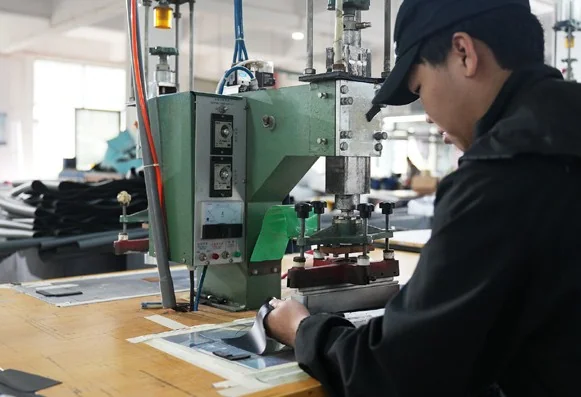
A fabric specification does not describe every route through which water might reach a bag’s contents. Seams, openings and attached components also need review. When comparing a welded or sewn bag, ask for a construction map rather than relying on a single process label.
Map the protected boundary
Identify the compartment that is intended to provide protection. Mark where panels join and where handles, straps, pockets or logos attach. Some accessories may be outside that boundary. Others may change its construction. The sample review should show which is which.
Ask how each joint is made
For a welded joint, ask the factory to explain the relevant material combination and joint design. For a sewn joint, ask how its construction supports the intended use and whether any additional treatment is specified. Neither word alone establishes a finished-bag waterproof rating.
Inspect the corners and transitions where different components meet. A long, straight panel joint may not represent what happens beside the opening or at a heavily used attachment point. Ask for close-up photographs of those areas on the actual sample.
Connect inspection with the use case
- Identify whether the requirement concerns rain, splash or another specified exposure.
- Define how the sample is loaded and closed.
- Record which joints and attachments are included in the review.
- Agree the test method, sample identification and acceptance criteria.
- Retain the report and any construction changes made afterward.
Recheck when a feature changes
Adding a pocket or moving a carry attachment may change more than the appearance. The development record should identify whether the change affects the protected compartment and whether another verification step is needed. Do not reuse a result from a previous revision without checking its scope.
A practical approval file contains a drawing, joint photographs and the agreed performance evidence. This helps purchasing, quality and production teams discuss the same construction instead of using waterproof as an undefined description.
Review seam transitions before the bag is closed
Seam intersections, corners and reinforcement edges deserve individual attention. A straight seam sample may not reproduce the thickness changes or access constraints of the finished bag. Ask how the selected join will be formed at those transitions and which checks can still be performed after assembly.
Use the sample review to separate appearance from function. An even-looking seam does not by itself establish strength or water protection. Record the seam type, relevant material references and the agreed evaluation method so later production checks address the intended requirement.
When a leak or separation appears, identify the location, loading state and construction revision. Change one relevant factor at a time where practical and retain photographs of the original issue. This makes the next sample a traceable correction rather than an unrelated rebuild.
Seam-review record
| Review area | What to define | Decision or evidence |
|---|---|---|
| Straight joins | Consistency and material alignment | Use as a starting point, not whole-bag proof |
| Corners and intersections | Layer build-up and transitions | Inspect the actual assembled detail |
| Anchor areas | Stress transfer and added penetrations | Review reinforcement with the intended load |
Does welded construction remove the need for inspection?
No. The suitability of the material combination, joint design and process still matters. Review the actual product and agreed acceptance criteria; the presence of welding equipment does not establish a finished bag’s rating.
For the next development decision, see our Waterproof Bag Construction: A Buyer Checklist Beyond the Fabric Name.
Review our waterproof bags and the related procurement guide. To discuss a specific design, send Weierken your product brief with the intended use, quantity and destination market.
From brief to sample
Build the right bag for your collection.
Share the intended use, product format, quantity and destination market. Weierken can review the construction and sampling requirements with your team.
Discuss your bag project Explore OEM & ODM