
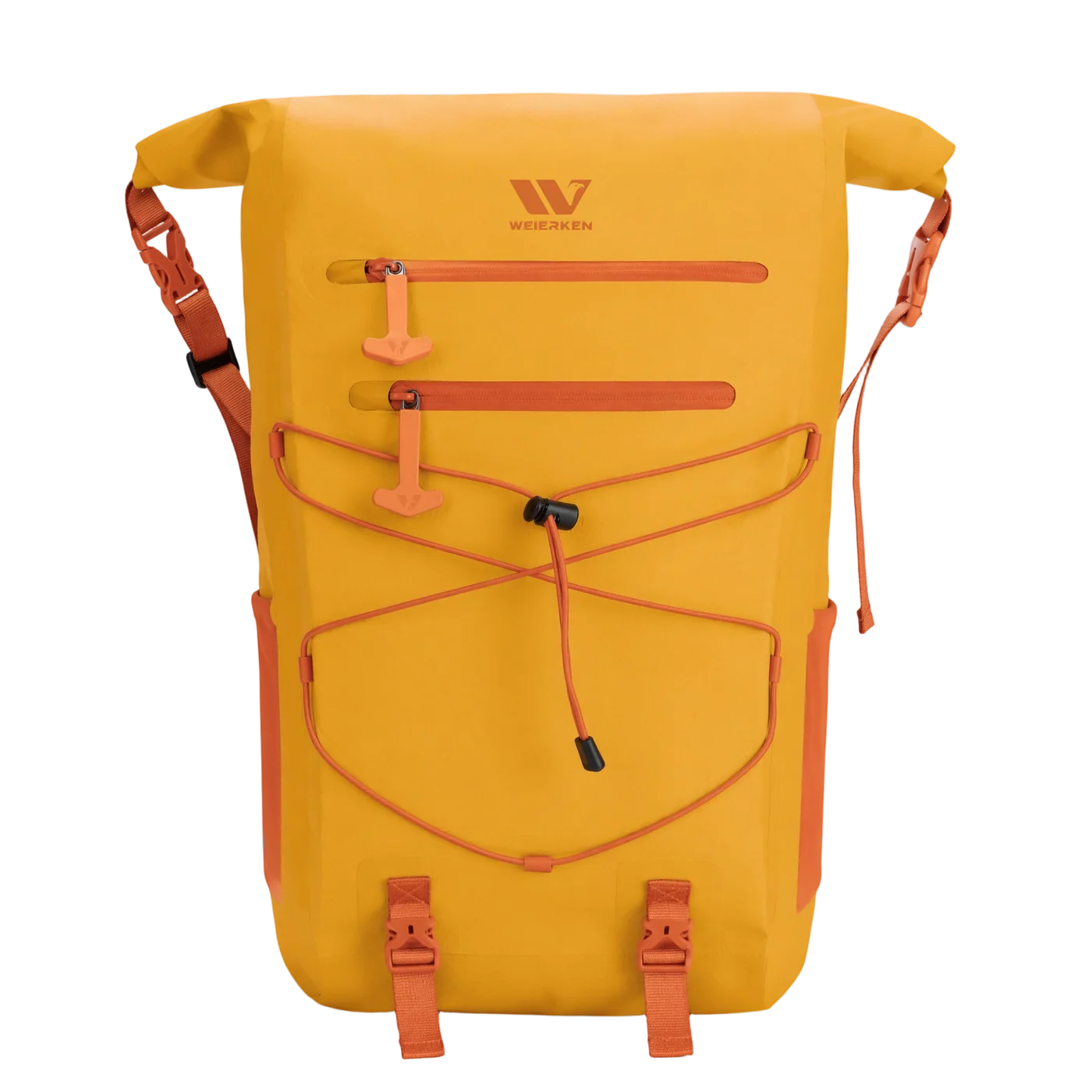
An external bungee cord is often shown with no gear under it. That makes the front panel look tidy but leaves the real purchasing question unanswered: can users still reach the pockets once something is stored there? A custom waterproof backpack brief should show both the retained item and the access route around it.
Name the item the cord is meant to retain
“External storage” is not a complete requirement. A folded jacket, a soft towel and a rigid object behave differently under an elastic cord. State the intended item, packed dimensions and condition, including whether it is expected to be wet. Do not assume a decorative cord is suitable for heavy or safety-critical loads.
Weierken’s W13 gear-ready roll-top backpack has a front bungee, quick-access zippers, webbing loops and lower straps. This platform makes the interaction visible: the front gear zone and the pocket openings share limited space. A customized version needs its own layout review.
Review access with the external item installed
Place the nominated soft item under the cord in the orientation users will follow. Photograph the front, side and top edges. Then open each quick-access pocket and remove the actual item expected inside. A zipper that can move slightly is not necessarily an accessible pocket.
Check whether a zipper pull disappears behind the stored gear, whether the cord crosses its travel and whether the user must release the external item completely. If release is necessary, decide whether that is intentional. Do not advertise simultaneous easy access when the demonstrated sequence requires unloading the front panel.
Repeat with the main compartment packed. Body expansion can change the distance between cord anchors and pocket edges. Empty-bag clearance is not enough for a final decision.
A useful layout review example
This is an illustrative brief rather than a verified load or performance specification for W13.
| Configuration | Buyer-supplied item | Decision to document |
|---|---|---|
| Bungee in normal use | Folded lightweight jacket | Which zipper remains accessible without removing it? |
| Main body fully packed as intended | Usual internal load plus the jacket outside | Does body expansion change cord routing or access? |
| External item removed | Empty front cord zone | Where do the cord tail and adjuster rest? |
| Lower straps also used | Separately identified soft accessory | Do the two attachment zones interfere with one another? |
Mark the intended cord route on the photograph. Without that detail, a revised sample may look acceptable only because someone laced the same cord differently.
Keep cord retention separate from waterproof claims
External gear retention and main-compartment water protection are different functions. A front zipper pocket should not be assumed to share the main compartment’s protection level. Identify what each compartment is intended to hold and what evidence supports any claim about it.
Any new anchor or altered attachment also needs a construction review. The development team should identify whether the change affects a panel, seam or reinforced area. Do not request an extra anchor at an arbitrary point and assume the original protection evidence still applies.
For the broader attachment discussion, see our backpack lash-point review. This article focuses specifically on access conflicts between an elastic front zone and nearby pockets.
Agree an operating sequence and photograph it honestly
Decide whether users should release the cord, move one edge of the jacket or use a different pocket for frequently needed items. A clear sequence can be appropriate; not every problem requires another pocket or additional hardware. If the routine is too awkward, compare a different cord position or an independent storage zone.
Retain the packed configuration photos with the approved sample record. For marketing, show the nominated item under the cord rather than a much smaller prop that makes the system appear more spacious. Avoid implying that unrelated heavy equipment is approved for the elastic zone.
Before a quotation, provide the front-panel artwork too. Stored gear can cover a logo, label or reflective feature. Reviewing branding and access together helps avoid moving a pocket after the visual design has already been approved.
Procurement FAQ
Can a bungee hold any external equipment?
No. Define the intended item and agree suitable retention and durability requirements for that use. An elastic cord should not be treated as a verified heavy-load attachment merely because an object fits beneath it.
Should every front pocket remain accessible when the cord is loaded?
That depends on the intended routine. State which items need immediate access. If a pocket requires unloading the cord zone, make that limitation explicit or revise the layout.
Can we add another cord anchor to an existing waterproof backpack?
It needs review. The anchor location, attachment construction and effect on the surrounding panel must be assessed. Existing water-protection evidence should not automatically be carried over to an altered structure.
Discuss your project with Weierken
Share a front-view gear layout with Weierken, including the stored soft item, pocket contents and logo zone, to review a practical bungee configuration. Send your project brief with the intended quantity, market and reference files. Pricing, sampling, MOQ and delivery commitments are confirmed for the agreed specification, not assumed from this guide.
From brief to sample
Build the right bag for your collection.
Share the intended use, product format, quantity and destination market. Weierken can review the construction and sampling requirements with your team.
Discuss your bag project Explore OEM & ODM