
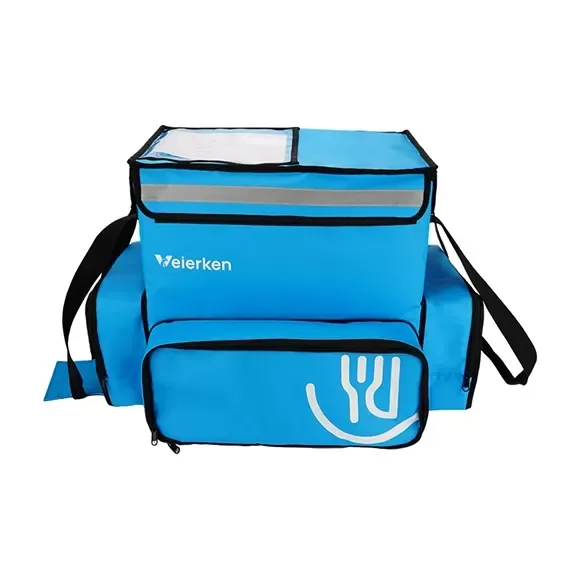
A delivery bag can fit on a shelf and still be awkward to load, remove or reopen there. It can also look square enough to stack without having a verified load-bearing design. Buyers should treat shelf clearance, access and stacking capability as three separate procurement questions.
For a Weierken insulated delivery bag brief, show where the carrier will be stored and handled. A photograph of an empty bag on a table cannot establish that it will work beneath a low shelf or support another loaded carrier.
Measure the route onto the shelf, not only the final position
Record usable shelf width, depth and vertical clearance. Include any front lip, bracket, door frame or trolley handle that narrows the route. A bag may fit behind the shelf edge but need more space to pass through the opening with its handles in a normal position.
Use the normally packed sample, with the actual food containers inside, for the fit review. Photograph the front and side profiles rather than measuring only the empty shell. A protruding container lid, pocket contents or a raised carry handle can change the practical envelope without changing the catalog’s stated capacity.
Start with the Weierken product range and identify the reference construction in your brief. The photograph here is a starting reference, not a statement that DBS04 has been validated for your shelf or vehicle.
Write the loading and handover sequence
Ask whether the bag will be filled on the shelf, filled elsewhere and slid into place, or removed before every opening. Top access needs a different clearance review from front access. If staff must remove another carrier just to open the lower one, document that inconvenience instead of hiding it in a showroom arrangement.
Cambro’s insulated transport selection guide distinguishes carrier types and access arrangements. That structure is useful for asking operational questions, but the performance of its molded carriers cannot be transferred to a soft Weierken bag.
Include the real hand position during lifting and removal. Do not assume that a fabric loop will remain accessible when it is pressed against a shelf wall. Our delivery bag fit guide covers the surrounding vehicle or carrier dimensions; this review adds the shelf-level operation.
A filled shelf-fit worksheet
This is an illustrative workflow, not a test result or an approved loading limit for the pictured product.
| Operation | Illustrative check | Record |
|---|---|---|
| Place a packed bag on the shelf | Move it through the front opening with normal handles attached | Front-opening dimensions and a continuous placement video |
| Open the bag in position | Check lid travel without moving the shelf above | Photo of the lid in its natural fully open position |
| Retrieve the first order | Reach the nominated container without pulling the bag forward | Packed layout and hand-access observation |
| Remove the carrier | Check grips and a clear route with adjacent bags present | Removal video and any contact points |
Give each issue an accept/revise decision. “Make it fit better” becomes a specific instruction such as reviewing a handle position that catches the front lip. Retest the same arrangement after a change.
Do not convert a fit result into a stacking claim
Stacking raises different questions: which parts carry the load, how compression changes the contents, whether closures remain usable and how the assembly behaves during the intended handling. The required evaluation must be appropriate to the finished construction and operating conditions.
Until that capability has been established, plan separate supported shelf positions rather than treating an unverified soft lid as a structural support. Do not publish an invented number of stackable layers or a maximum upper-bag weight. A rigid insert or frame is not, by itself, a verified stack rating for the assembled carrier.
If a project needs internal supports, review the removable-frame guide as a separate construction question. Changes to a frame, panel or handle can require another fit and handling review.
Keep the operational drawing with the sample approval
Provide an annotated shelf or trolley drawing, normal contents, loading direction and photographs of the actual work area. Mark fixed dimensions separately from preferences. If the shelf cannot change, that is a different brief from a project where a wider opening or a dedicated rack position is possible.
Link the final fit evidence to the approved model and revision. The order specification should state what was reviewed without implying a broader structural, thermal or food-safety approval. Those requirements, commercial terms and any verification scope need their own project-specific agreement.
Procurement FAQ
Does a square shape mean a delivery bag is stackable?
No. Shape alone does not establish load paths, stability or compression behavior. Request a construction-specific evaluation before using stacking language.
Should shelf clearance include the handles?
Include every component that occupies the loading or retrieval route in its normal operating position. If handles must be stowed first, document that action and check whether staff can perform it consistently.
Can empty-bag measurements be used for the final fit decision?
Use them as preliminary information, then review the intended packed arrangement. Soft panels and pocket contents can change the practical envelope.
What evidence helps Weierken review the layout?
Send the usable opening dimensions, shelf lip and obstructions, packed container list, loading sequence and a short video of the current handling task. Identify any required structural assessment separately.
Plan your delivery carrier layout
Send Weierken your delivery bag brief with the work-area drawing, reference model and expected quantity. Clear fit and handling requirements are more useful than an unsupported request for a “fully stackable” soft bag.
From brief to sample
Build the right bag for your collection.
Share the intended use, product format, quantity and destination market. Weierken can review the construction and sampling requirements with your team.
Discuss your bag project Explore OEM & ODM