
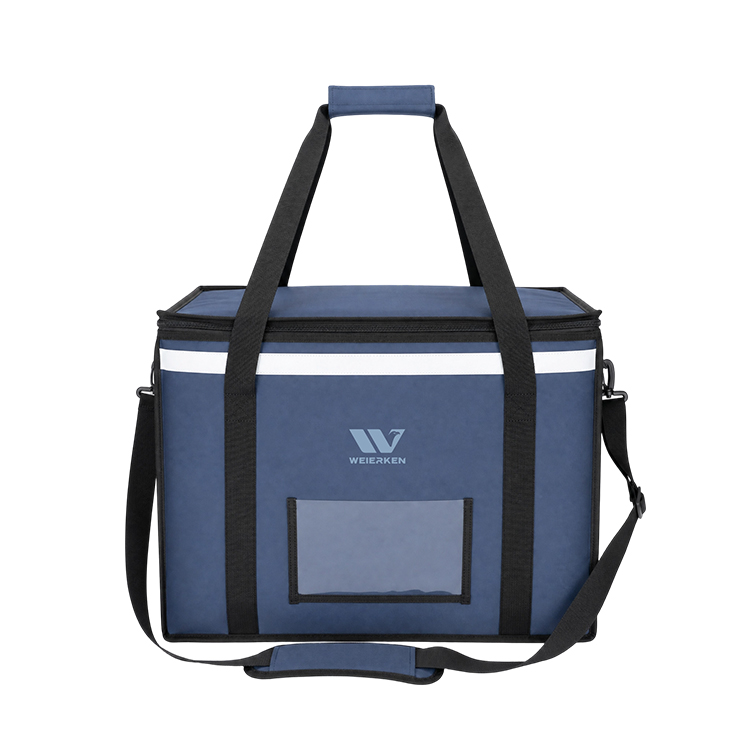
A catering tray can fit inside an insulated bag and still be difficult to load or remove. The tight point is often the zipper mouth, the lid hinge, or the space a worker needs to keep both hands on the tray. Specify those clearances separately before approving a custom catering delivery bag.
The Weierken DBS049 is a wide, rectangular, top-loading bag reference. Its format helps illustrate the opening review below. The photo does not establish tray compatibility, a maximum load, or a particular opening dimension. Use the actual closed container and a physical sample to make those decisions.
Measure the closed tray, not its nominal size
Start with the longest and widest projections in the packed configuration. Include the flange, lid locks, carry tabs, and the base if any of those extend farther than the tray body. Measure height from the supporting surface to the highest point of the closed lid. Record whether the handles are fixed, folded for transport, or held open while loading.
Give the same tray a reference number on the drawing and on three photographs: top, end, and side. Mark where a hand can approach the grip. A tray with end handles and one with side grips can have similar dimensions but need different loading paths. If the kitchen uses more than one tray, review the worst case for each dimension and each handling position rather than assuming one tray is the largest in every way.
As a useful example of specification structure, Cambro lists exterior dimensions, interior dimensions, and pan capacity separately for its rigid top-loading carriers. Keep those fields separate for a soft bag too, and add the narrowest usable opening. The Cambro figures do not specify compatibility with DBS049.
Specify three different fit checks
- Passage through the opening: Check the narrowest gap along the route of the closed tray, including the zipper tape and the corners. Decide which end goes in first, and whether the tray must remain level throughout.
- Hand clearance during transfer: Check that the person loading the bag can lower the tray onto its support and remove both hands without forcing the opening. At the unloading end, check that the same grips can be reached before the tray has to move.
- Clearance after the lid closes: Check the highest lid feature, zipper travel around the corners, and any pressure from the bag lid. A tray that can enter the cavity can still obstruct closure.
Use the intended counter or shelf for the review. A lid may open fully on a clear workbench but hit a back wall or overhead shelf at dispatch. If the task requires the bag lid to stay out of the loading path, use the delivery bag lid-support guide to document that requirement separately.
Worked example: a 5 mm gap is not a grip allowance
Illustration only; not DBS049 dimensions or a recommended tolerance. Suppose a closed sample tray is 480 mm long at the body and 520 mm across its projecting end handles. A candidate opening measures 525 mm along that axis at its narrowest point. The nominal total gap is 5 mm, or 2.5 mm per end when perfectly centered. That arithmetic does not show that hands can pass the zipper edge or that the tray can remain level. Check hand position separately, then change the opening, loading orientation, or container selection if the sample fails.
| Record | How to check | Release condition |
|---|---|---|
| Closed tray and handle envelope | Identify tray, lid and handle position; measure the furthest projections. | Drawing and measured sample describe the same configuration. |
| Narrowest opening | Measure between obstructions along the intended level approach. | Tray passes without pulling the zipper tape or scraping its corners. |
| Grip access | Lower and lift a cool, empty trial tray using the intended grips. | Hands can reach and leave the grips without trapping or tilting the tray. |
| Closed lid clearance | Place the tallest closed tray in the planned position and close the zipper normally. | No lid projection blocks the zipper, and closure does not require forcing it. |
| Representative packed setup | After the empty fit check, review an agreed inert load and actual handover location. | Repeatable loading and removal under the agreed conditions; any separate carry or thermal requirements remain independently documented. |
Keep the fit decision separate from the delivery program
Document which tray, lid, route equipment, and sample were used. If a supplier changes the lid locks or handle geometry, repeat the affected checks rather than relying on the tray body’s catalogue size. For a route with different trays, note whether a single configuration really works or whether separate bag sizes reduce handling compromises.
A fit check does not verify temperature performance or safe carrying limits. Record any loaded handling, insulation, sanitation, or vehicle restraint requirements in the delivery bag program brief and assess them separately. Do not use hot food to troubleshoot a new opening or a grip obstruction.
Send a custom catering bag enquiry with the tray reference, maximum closed dimensions, grip photos, loading direction, route setup, and the pass conditions above. This gives the development team a clear starting point for an opening and a sample review without assuming a catalogue format already fits.
Frequently asked procurement questions
Is the bag’s internal length enough to decide if a tray fits?
No. Record the narrowest opening and any intrusion from the zipper or lid as well. A closed tray that rests inside the cavity may be unable to pass through the opening in the required orientation.
Should fold-down handles be measured folded or open?
Measure both states if you carry the tray with the handles open and store it with them folded. Check the movement between those states at the opening and verify that the grip can still be reached at unloading.
Can a drawing replace the sample test?
Use the drawing to screen dimensions and show the loading direction. Verify the flexible opening, hand clearance and normal closure with the actual tray or a representative cool sample before releasing the construction.
Does DBS049 fit a standard food pan?
No compatibility is established here. Provide the pan, lid, handles and the intended use. Review the measured envelope and approach on a sample before confirming any specific combination.
From brief to sample
Build the right bag for your collection.
Share the intended use, product format, quantity and destination market. Weierken can review the construction and sampling requirements with your team.
Discuss your bag project Explore OEM & ODM