
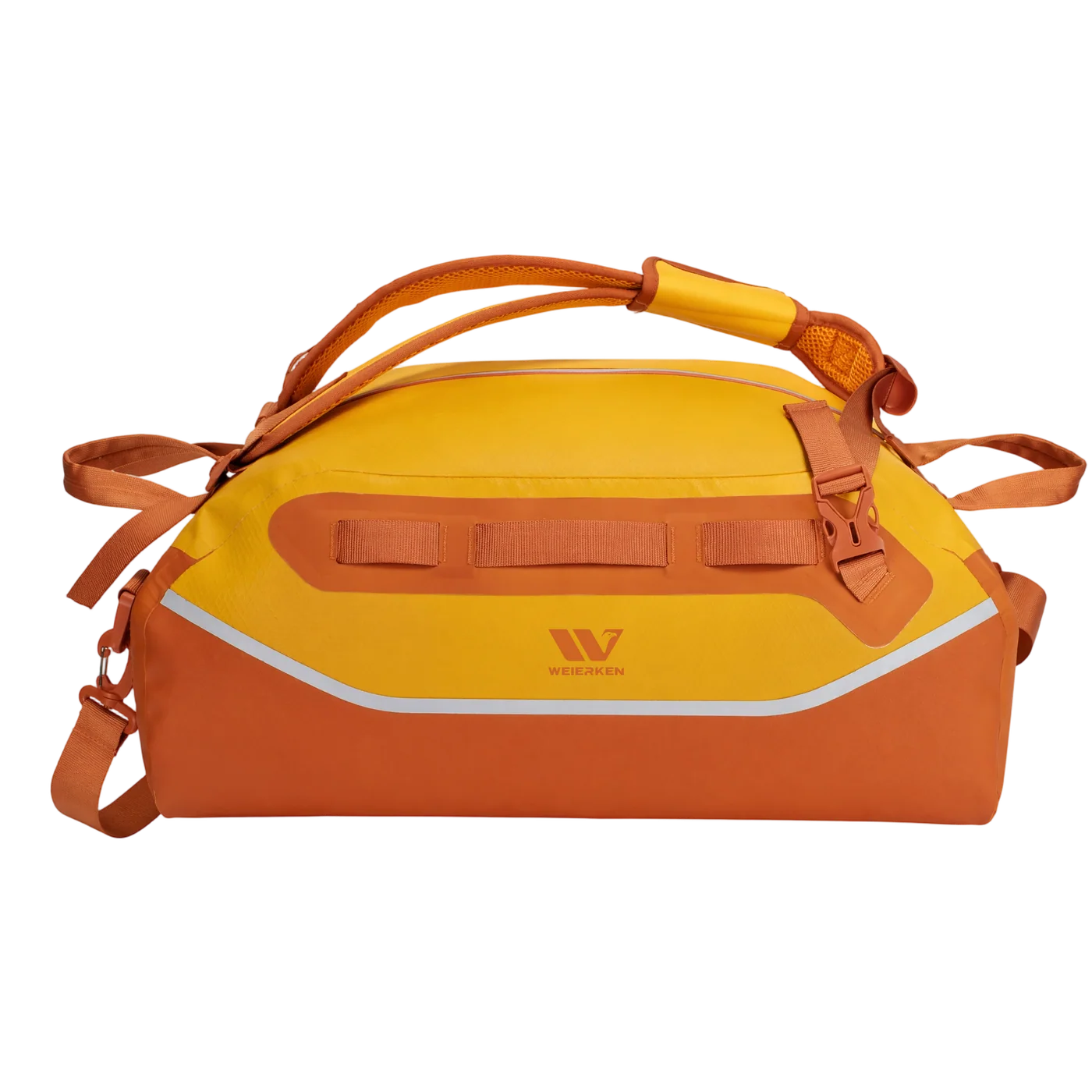
For waterproof duffel bag trolley sleeve proposal, define the purchasing and acceptance boundary. A trolley sleeve should be reviewed with the proposed duffel and the luggage handle it is intended to fit. Define the use and reference luggage before asking for the sleeve dimensions. The orange duffel photograph identifies the bag family; it does not prove that a sleeve is fitted or compatible with the buyer’s suitcase. Ask Weierken to confirm the actual modification, sample and commercial scope.
Identify the reference luggage interface
Provide the handle arrangement and the relevant reference sample or controlled drawing. State how the customer intends to place and carry the duffel. Do not infer sleeve fit from a generic suitcase photograph or the duffel’s nominal capacity. The buyer should identify who evaluates the complete loaded arrangement and retain that reference when the supplier proposes the sleeve construction and position.

Review the sleeve as a proposed assembly
Ask how the sleeve attaches to the bag and how its openings are defined. Review access to adjacent pockets and carrying handles on the sample. The conceptual drawing separates the luggage interface from the bag body without specifying a manufacturing dimension. Keep fabric, reinforcement and assembly decisions with the actual supplier proposal, and record any requested change before the bulk sample is approved.
Keep bag claims and sleeve fit distinct
A sleeve fit check does not establish a load rating, waterproofness or safe use on every luggage system. State the intended contents and request the evidence appropriate to the actual specification. If the reference suitcase or bag construction changes, ask whether the accepted interface needs another review. Retain the earlier sample and the reason for revision so compatibility is not assumed across an undocumented substitution.

Request a complete production offer
Send the intended use, bag dimensions, luggage reference, sample quantity and production demand. Include materials, logo, market, packaging and delivery needs. Ask whether the trolley sleeve is part of the offered standard bag or a separately quoted modification. Keep the approved sample identity and requested evaluation evidence with the order, leaving cost, quantity conditions and delivery subject to the supplier’s actual confirmation.
Compare the proposed supply and its evidence
| Buyer need | Recommended product | Key specification | Why it matters |
|---|---|---|---|
| Reference luggage handle identity | Identified custom bag configuration | Order-specific scope and responsible reviewer | Connects the record to the item being purchased |
| Sleeve attachment and opening proposal | Identified custom bag configuration | Order-specific scope and responsible reviewer | Makes an important comparison condition visible |
| Loaded sample review and claim limits | Identified custom bag configuration | Order-specific scope and responsible reviewer | Separates observation from an assumption |
| Approved duffel and sleeve revision | Identified custom bag configuration | Order-specific scope and responsible reviewer | Preserves the accepted delivery decision |
Best for defined industrial projects
Best for engineering teams, industrial purchasing managers and distributors preparing an identified custom bag order. Suitable for a project with a documented application, quantity, technical owner and acceptance procedure. Not suitable for inferring a universal equipment capability, fixed commercial term or verified order result from a catalog image. Confirm the offered configuration and the project-specific evidence before approving production supply.
Buyer questions before requesting a quotation
What information should accompany the first RFQ?
Describe the application, destination, proposed configuration, quantity and target delivery date. Include the reference luggage handle identity and identify the person who owns technical approval. Send the relevant drawings, process information or specification revision when available. Ask the supplier to return a proposal that distinguishes confirmed requirements from assumptions, exclusions and options, so the industrial purchase can be reviewed against a clear scope.
Does a general catalog establish this acceptance requirement?
A general catalog provides product context and can help identify the family to discuss. It does not establish the sleeve attachment and opening proposal for the actual order. Ask the supplier to confirm the proposed arrangement and the evidence that will accompany it. Keep product identity, a requested feature, a completed demonstration and the final acceptance decision separate when assessing whether the requirement has been met.
Which documents should the buyer retain?
Retain the accepted technical offer, applicable configuration and revision identities, relevant inspection records and the delivery disposition. Preserve the loaded sample review and claim limits together with any deviation and its review. The useful record connects an observation with the actual supplied item and requirement. An unrelated brochure, image or unconfirmed numerical claim should not replace the evidence specifically required for the project purchase.
Can the documentation and supply scope be customized?
Submit the requested documentation, packaging, identification or other supply change with the inquiry. Include the approved duffel and sleeve revision and explain the intended use. Ask Weierken to confirm feasibility, quantity conditions and the effect on price or delivery in the actual proposal. Keep the agreed revision with the order rather than assuming that every requested customization is standard or already included.
How should technical approval and delivery be scheduled?
Close the technical scope, approval owner and outstanding questions before requesting a firm production commitment. Include the reference luggage handle identity, required quantity, destination and target arrival date. Distinguish document review, any agreed evaluation, production completion and transportation. This guide establishes no inventory position, minimum order or fixed lead time; the supplier must confirm those commercial conditions for the actual configuration and project.
Connect this review to the complete project specification
Describe the actual contents, intended use, destination market, proposed bag dimensions and expected carrying arrangement in the inquiry. Submit relevant component references, artwork and packaging requirements, and ask which details require a sample or technical review. A photograph establishes a useful product-format reference but does not confirm capacity, load limits, insulation performance or waterproofness for the proposed order. Those claims require the appropriate supplier evidence and agreed evaluation. Keep the reference sample revision distinct from a requested customization. State trial quantity, production quantity, logo needs and target delivery dates. If the contents, accessory or closure changes, identify the affected review and retain the revised sample approval. The interface described in this guide should be considered alongside materials, construction and the full project requirements before releasing an order for bulk manufacture.
Send an identified industrial supply inquiry
For a quotation, provide the application, project country, required quantity, technical specifications, relevant drawings, testing requirements, packaging or OEM needs and target delivery schedule. Identify the unresolved acceptance questions and the person responsible for reviewing the proposal. Contact Weierken with the project details to request an actual technical and commercial offer. Keep a proposed value clearly labeled until it is confirmed for the supplied configuration.
From brief to sample
Build the right bag for your collection.
Share the intended use, product format, quantity and destination market. Weierken can review the construction and sampling requirements with your team.
Discuss your bag project Explore OEM & ODM