
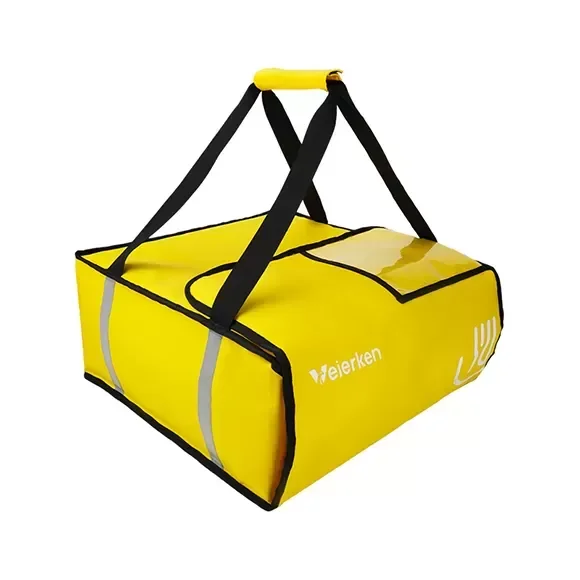
For pizza delivery bag partial load approval, start with the smallest normal order and the actual box dimensions, then compare them with the fuller reference load. Check the closure position, box movement and intended handover procedure under an agreed development review. Keep that fit assessment separate from any thermal performance requirement. The resulting approval matrix should tell the purchasing team which combinations have been reviewed, which remain open and what changes require another sample. This prevents a maximum capacity statement from being treated as evidence for every order size the delivery operation will handle.
A pizza carrier that works with a full stack can behave differently with only one box inside. The lid may sit differently, the handles may pull the sides inward and the load may move during handover. A procurement review should therefore cover the smallest normal order as well as the largest proposed order.
Weierken’s delivery bag development brief can use an order-size matrix to connect the box format, number of boxes, closure position and carrying method. This guide focuses on partial-load approval, rather than repeating the basic pizza bag sizing question. The aim is to define usable operating arrangements across the real order mix.
List the actual order combinations
Collect assembled boxes, not only their nominal pizza-size names. Record outside length, width and closed height, including protruding tabs or labels. Note combinations that are commonly delivered together: one box, mixed box sizes, or a stack with an additional flat package. Keep drinks and other accessories as separate requirements unless the proposed design provides an appropriate place for them.
Cambro’s standard pizza bag specifications distinguish box combinations and bag dimensions for its products. They illustrate why box count needs a stated format. Their capacities and cleaning instructions are not Weierken specifications.
Review the smallest order before approving maximum capacity
Place the smallest normal order in the sample and close it using the proposed operating method. Observe whether the closure engages consistently, whether fabric drops into the handover opening, and whether the handles can be gathered without twisting the package. Record the position rather than compressing the carrier until it looks neat for a photograph.
If the design needs a removable support or adjustable closure, document its configuration for that order. A rider should not have to invent a different setup at every stop. Retain photos of the approved small-order arrangement beside the full-order arrangement.

Write the loading and removal sequence
Identify the loading side, the first box inserted and the first box removed. Check hand clearance with the intended packaging. If a document pocket is used, decide whether it holds an internal order identifier or customer-facing paperwork; avoid unnecessary personal information on an exposed surface.
Review the operating sequence without assuming a thermal or food-safety result. A bag-fit review is not a temperature-validation study. Any temperature-control requirements, route duration and food-handling procedures belong with the operator’s responsible team and the agreed validation scope.
A filled partial-load approval matrix
The following entries demonstrate a fictional purchasing worksheet. They are not capacity claims for DBS03 or a completed customer trial.
| Order condition | Question to resolve | Approval evidence |
|---|---|---|
| Single assembled box | Does the selected closure position remain usable without forcing the box? | Closed sample photo and closure-position note |
| Normal repeated order | Can the operator load and remove the box without catching tabs? | Short sequence video with the actual box |
| Largest proposed combination | Is there adequate access and no unintended box compression? | Packed dimensions and accept/revise record |
| Mixed-format order | Is an insert or separate carrier needed rather than an improvised arrangement? | Approved configuration drawing or exclusion from the range |
Treat box and closure changes as revision triggers
A new carton supplier, thicker box wall or different folded tab can change the fit even if the menu still uses the same size name. Keep one physical reference box or a controlled drawing with the bag approval. If a box changes, check the affected order combinations before reusing the approval.
The same discipline applies when changing the carrier’s closure or support panel. Record the previous version, revised part and observations in the sample revision record. Where a component change affects packing, update the packaging specification as well. Avoid approving a feature in isolation from the operating arrangement.

Who this development brief is for
Best for: brand sourcing teams, distributors and product developers preparing an OEM sample review. Suitable for: a defined industrial or commercial bag project with an identified approval owner. Not suitable for: inferring a load rating, protection claim or universal compatibility from a reference photograph alone. Record the required order quantity, destination, packaging and delivery objective in the RFQ.
Procurement FAQ
Is the maximum box count enough to choose a pizza bag?
No. Specify the exact box format and review the smallest normal order, normal order and largest proposed combination. A maximum count does not describe closure or handover behavior at partial load. Keep the accepted combinations in a controlled matrix that identifies the box revision and closure arrangement. When a store changes its packaging, review the affected combination before applying the previous approval. Record which configurations remain outside the agreed sample review.
Can we put a smaller box in the same carrier?
It may fit dimensionally, but the approved review should also cover movement, closure and handling. Do not assume a smaller package is automatically a suitable operating configuration. Use the assembled sample and the intended carrying method to check the proposed combination. Identify any restraint or divider that forms part of the approval. Ask the supplier to confirm construction changes and keep them with the sample revision before ordering that arrangement.
Does a fit review prove heat retention?
No. Thermal performance requires an appropriate separate brief and evidence for the actual construction, load and operating conditions. Define the temperature related requirement with the responsible food operation and agree suitable evidence for the intended duty. Keep the thermal evaluation linked to its actual load, procedure and sample revision. A dimensionally acceptable carrier should not be described as thermally qualified solely because the boxes fit.
What materials should the buyer send for sampling?
Provide assembled reference boxes or accurate drawings, the common order combinations, loading photos and the intended carrying arrangement. Include brand artwork and expected quantity as separate quotation inputs. Mark the most frequent order sizes and identify any unusual combination that still matters operationally. Assign a sample or drawing revision to the packaging information. Ask which assumptions the supplier used in its proposal and resolve differences before approving a larger production quantity.
What change should trigger a new partial load review?
Review the affected combinations when the box dimensions, order mix, carrier construction, closure or carrying arrangement changes. The responsible team should decide which previous observations remain relevant and which must be repeated. Keep the decision with the packaging and bag revision. A repeat order should reference the approved arrangement rather than relying on an old maximum box count that no longer describes normal deliveries.
Prepare a delivery bag brief that reflects real orders
Review the Weierken product range and send your pizza delivery bag brief with the order matrix. Weierken can review the construction questions against that brief; commercial and performance commitments remain project-specific.
From brief to sample
Build the right bag for your collection.
Share the intended use, product format, quantity and destination market. Weierken can review the construction and sampling requirements with your team.
Discuss your bag project Explore OEM & ODM