
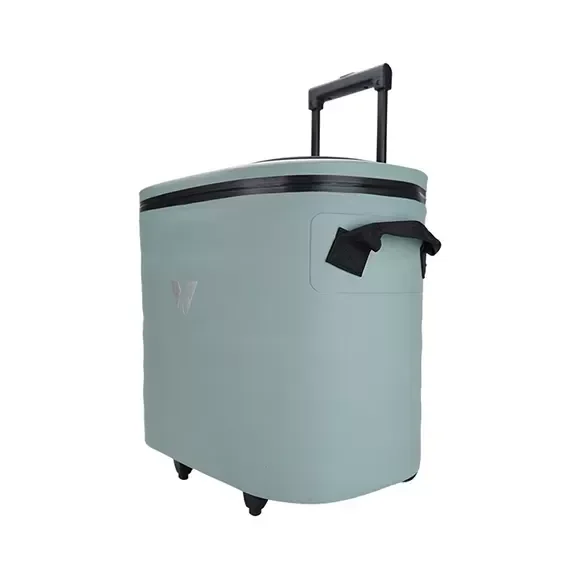
A custom trolley cooler bag mobility review should connect the intended route with the actual packed load before the buyer approves a sample. Identify storage, rolling, surface transitions and lifting as separate review stages. Send the relevant route photographs and the container layout with the RFQ, then ask which construction and evaluation steps suit that use. This makes the discussion more useful than choosing wheel appearance alone. Retain the accepted handling arrangement, sample revision and packing assumptions so that the order can be reviewed against a defined application rather than an unsupported all-terrain claim.
A trolley cooler is not simply a shoulder cooler with wheels attached. A buyer has to define the route, the filled load, the pull-handle position and the moments when someone must lift the bag. Those decisions affect the frame, wheel placement, base clearance and access to the cooler itself.
For a Weierken custom cooler bag brief, start with the journey from storage to the destination, rather than a request for “all-terrain wheels.” The following worksheet turns that request into sample-review tasks. It does not state a load rating or tested terrain capability for the pictured product.
Describe the route in sections
Record the loading point, doorway, parking surface, path and final resting place. Include transitions: a curb, a gravel edge, a narrow gate or the space beside a vehicle. A bag may roll comfortably on one section yet need to be carried on another. Photograph those transitions with a ruler or another agreed scale in view.
Separate normal conditions from occasional conditions. A retail program aimed at paved campsites should not acquire an unsupported beach-performance claim just because a lifestyle photograph includes sand. YETI’s Roadie FAQ discusses terrain limitations for its own wheeled products. The useful lesson is to describe the route explicitly, not to transfer another manufacturer’s capability to a soft Weierken trolley.
Define one repeatable packed configuration
List the actual containers, cooling packs and accessories used in the review. Record total packed mass separately from empty product mass. Note whether heavy items sit low, move during pulling or press against a flexible wall. An empty display sample cannot represent these conditions.
Keep this configuration with the empty-weight and packed-load specification. If the buyer changes the container layout later, repeat the relevant mobility observations rather than assuming that the previous result still applies. The agreed evaluation team should set appropriate test conditions and acceptance criteria; no universal kilogram limit is established by this article.

Review the handle at the user’s working position
On an appropriate controlled surface, review the extended grip position with the intended sample load. Look for interference between the user’s steps and the bag, contact between the pull handle and lid, and whether another hand is needed to keep loose straps clear. Record the user’s stance and the handle position so another reviewer can repeat the observation.
Also inspect the parked arrangement. Can the lid open with the handle retracted? Does the handle prevent access to an external pocket? Where are removable shoulder straps stored while rolling? These are different questions from handle strength and should have separate entries in the development record.
An example mobility review sheet
This is a fictional review brief, not a test report or a recommended route for CBS2511.
| Stage | Illustrative requirement | Record to retain |
|---|---|---|
| Loading area | Check the packed cooler fits the intended loading opening | Opening measurement and packed profile photo |
| Normal paved path | Review pulling clearance with the selected sample arrangement | Configuration ID, handle position and observation video |
| Unavoidable step | Define a separate lifting method; do not label ordinary wheels stair-climbing | Responsible handling review and suitable grab-point specification |
| Destination | Park the bag and access the contents without trapping straps | Open/closed photos and accept-or-revise decision |
Connect observations to construction changes
If the base contacts an obstruction, record where it happens rather than asking vaguely for “larger wheels.” A change in wheel size can affect axle location, packed dimensions and carton space. A change in pull-handle arrangement can affect access and reinforcement. Ask Weierken to review the connected construction questions together.
After any change, repeat the relevant sample task using the same load and route description. Retain the previous and revised photographs in the sample revision record. Do not turn an observed improvement into a broader endurance or all-terrain claim without suitable supporting evaluation.

Who this development brief is for
Best for: brand sourcing teams, distributors and product developers preparing an OEM sample review. Suitable for: a defined industrial or commercial bag project with an identified approval owner. Not suitable for: inferring a load rating, protection claim or universal compatibility from a reference photograph alone. Record the required order quantity, destination, packaging and delivery objective in the RFQ.
Procurement FAQ
Does adding larger wheels prove that a cooler works on sand?
No. The assembled product, packed load and actual surface matter. Specify the intended conditions and request a suitable evaluation instead of approving a general terrain claim from a photograph. Use the route description to choose representative transitions and a controlled evaluation arrangement. Record the packed load, pulling method and observed behavior. Treat untested conditions as open questions instead of extending a favorable observation into a universal terrain approval.
Can the pull handle replace the lifting handles?
Do not assume it can. Identify which components are intended for pulling and which for lifting, and agree the corresponding construction and verification scope. Ask the supplier to identify the intended handling points on the sample drawing and review them in the agreed evaluation. Keep any operating limitation with the approval record. A component used during rolling should not silently become an approved lifting point.
What should be included in the first quotation brief?
Send the reference format, container layout, packed-load information, route photos, handle/access requirements and order quantity. This is more actionable than specifying liters and wheel diameter alone. Identify the person who can answer questions about the intended handling sequence. State which observations decide acceptance and which construction details still need review. Ask the quotation to distinguish the proposed sample arrangement from specifications that the buyer has already approved.
Should carton dimensions be reviewed after a trolley change?
Yes. Wheels, base supports and a revised frame can change the packed envelope. Review the actual packing arrangement before comparing freight estimates. Keep the packing sample linked to the same product revision used for the mobility review. Note which components remain fitted during transport and how they are protected. Ask for confirmation of the proposed carton arrangement before it becomes an order requirement.
How should a mobility review support repeat orders?
Retain the reviewed sample identity, route description, packed-load assumptions and the accepted handling arrangement with the purchase specification. Ask how later production will be identified against that revision. If wheels, frame, handle or container layout changes, review the affected evidence before repeating the order. Record any deviation and its authorized disposition rather than assuming the previous approval covers every revised construction.
Build the trolley brief with Weierken
Explore the cooler bag range and send your trolley cooler project brief. Include the mobility worksheet and the expected order size. Sampling, verification, price, MOQ and delivery terms are agreed for the actual project.
From brief to sample
Build the right bag for your collection.
Share the intended use, product format, quantity and destination market. Weierken can review the construction and sampling requirements with your team.
Discuss your bag project Explore OEM & ODM