
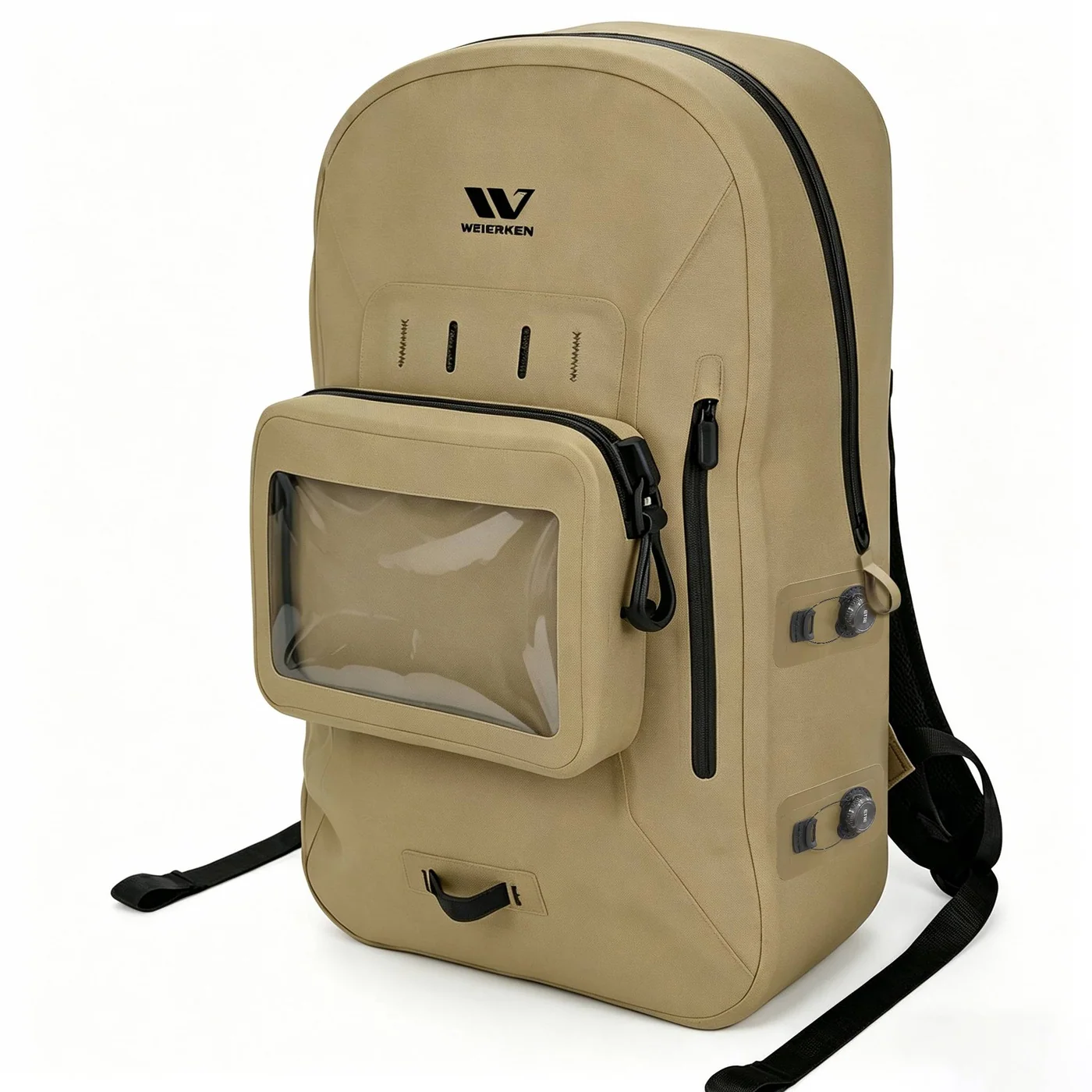
A detachable backpack pouch is a two-component system: the pouch and the main bag must be approved together. Looking at each component separately can miss misalignment, restricted access or an attachment that only engages when the main bag is empty. The buyer’s brief should describe the attached, detached and reattached states.
For a waterproof backpack OEM program, Weierken’s W12-26SS backpack with detachable magnetic front pouch is a useful format reference. Its listed features include separate front storage and a 600D TPU main body. The presence of a detachable pouch does not establish that the pouch has the same protection level as the main compartment, or that it fits a different backpack platform.
1. Define what the pouch does in each state
Start with the everyday sequence. Does the user remove the pouch while the pack remains on a chair, or detach it after putting the backpack down? Will the pouch be used independently, and if so, how is it carried? Describe the sequence without assuming that the attachment points are carrying handles or that the accessory is suitable for every load.
Also define what happens to the exposed interface after removal. Raised fittings may contact clothing or interfere with placing the main bag on a surface. A low-profile interface can reduce that concern, but its construction and retention still need review. Use the waterproof bag pocket-layout guide to separate access priorities from attachment details.
2. Record paired parts and the direction of engagement
The matrix below is an illustrative buyer worksheet, not a released Weierken component list. It is designed to prevent a supplier from changing one side of the interface without checking the other.
| Paired feature | Example instruction | Sample evidence |
|---|---|---|
| Locating positions | Use the same datum line on the pack and pouch drawings | Front-on photo with both component revisions identified |
| Engagement direction | Attach from the agreed direction without folding the pouch edge | Short sequence showing the fully loaded main bag |
| Release action | Use the nominated grip area rather than pulling the window | Record the hand position and access clearance |
| Independent use | Pouch carries only the agreed accessory set | Photo of the nominated contents and carrying arrangement |
| Replacement pouch | Match the approved interface revision | Physical interchange check, not just a matching name |
Put dimensions and tolerances on the component drawings where they matter. “Compatible with our backpack” is not enough if the backpack itself is being revised. A shared part number helps only when the underlying geometry and material arrangement are also controlled.
3. Repeat the attachment review with the main bag loaded
A flexible front panel can change shape when the bag is filled. Review the pouch with the main compartment lightly filled and with the nominated full load. Check whether the pouch can be attached without forcing alignment and whether it blocks a zipper pull, carry handle or access route. Record the load and position used for each observation.
Do not turn a casual pull on the sample into a published holding-strength figure. If a retention or cycling claim matters to the retail program, agree a test method, loading direction, cycle conditions and acceptance criteria. A magnetic connection, buckle or rail system each needs its own assessment; one method’s result does not qualify another.
4. Separate attachment performance from storage protection
The main compartment, pouch shell, pouch opening and interface may have different exposure boundaries. Ask which area is intended to protect the contents and which fittings are only for attachment. If a pouch carries a phone, review the device pocket and closure on their own terms rather than borrowing a rating from the backpack title.
Request clear consumer wording for both states. “Detachable front storage” is a structural description. Claims about immersion, theft protection or protective magnetic shielding require evidence beyond that description and should not be inferred. Weierken can review the requested construction through the customization brief; the final claim must match the approved product evidence.
5. Plan replacements without creating hidden incompatibility
If the pouch will be sold separately, state which main-bag revisions it is intended to fit. Keep old and new samples available during a transition. A color update can accidentally introduce a different attachment supplier, changed spacing or a stiffer patch that affects engagement, even though the merchandising name is unchanged.
Use the component-substitution review whenever a mating part changes. Save a paired-component photo, interface drawing and approval decision with the reorder specification. This is more useful than approving only the front-facing catalog photograph.
Frequently asked questions
Can a pouch from one waterproof backpack be supplied for another?
Only after the interface geometry, engagement, load and access are checked together. A similar appearance or nominal pouch capacity does not establish interchangeability.
Should the pouch and main compartment share one waterproof claim?
Not by default. Identify and assess each protected compartment and closure. Use wording supported by the exact assembly rather than transferring a main-bag claim to an accessory.
What should be checked if only the attachment component changes?
Check both mating sides, installation position, loaded alignment, release action and any agreed performance requirements. Update the component and sample revisions together.
Send a focused project brief
Send drawings of both the main bag and pouch, a list of intended contents and a short description of how the user removes and carries the pouch. Request a Weierken manufacturing review with your company, product format, quantity, destination market and drawings. MOQ, sampling arrangements, pricing and delivery timing must be confirmed for the actual specification.
From brief to sample
Build the right bag for your collection.
Share the intended use, product format, quantity and destination market. Weierken can review the construction and sampling requirements with your team.
Discuss your bag project Explore OEM & ODM