
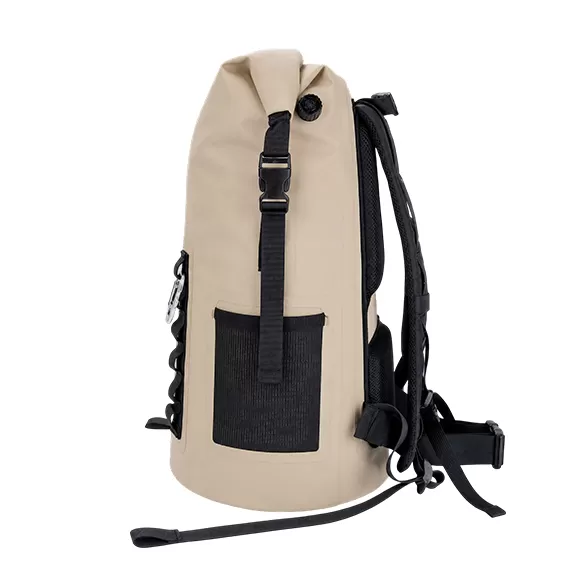
A roll-top bag can have the correct nominal capacity and still be awkward to close when it is packed. Buckle position, webbing routing and the available folding space need to work together. For a custom roll-top program, review the complete closure on the loaded sample instead of approving the buckle as an isolated accessory.
Start from the intended packed height
Load the agreed container or gear set and mark the space left for closure. Follow the proposed closing instructions rather than adding an arbitrary number of folds. The exact procedure must suit the selected construction and any claim the buyer intends to make.
Record whether users may compress the contents or need to protect a rigid item. If the load leaves insufficient closure space, forcing the buckle together is not a sound way to approve the capacity.
Review the buckle ends as a pair
Check that the matching parts reach each other without twisting the folded opening. Observe how the webbing is threaded and whether adjustment remains possible in the intended carrying position. A component drawing alone may not reveal interference with a handle, pocket or logo patch.
Use the actual sample hardware. Similar-looking buckle parts from different sources should not be assumed to fit each other. If the sourcing plan changes, the assembled closure requires another review.
Test access without making unsupported protection claims
Have the intended user open, load and close the bag several times under an agreed usability review. Include the gloves or wet-hand condition if relevant. Record missed engagements, confusing strap routing and contact with the contents.
This observation does not establish a waterproof or submersion rating. Closure usability and protection performance are separate requirements. Any claimed protection level needs a suitable test of the complete bag in its specified closed condition.
Capture one approved closure sequence
Photograph the open state, folding stages, engaged buckle and final adjustment. Link those images to the usable loading limit and sample identifier. This gives the buyer, factory and distributor a common instruction.
If the bag height, opening reinforcement or carrying strap is later revised, repeat the sequence. A small positional change can make the old instruction difficult to follow even though the buckle supplier and material remain unchanged.
Purchasing worksheet
Use this as a project worksheet, not a completed test report. Swipe the table on a small screen.
| Stage | Check | Record |
|---|---|---|
| Loaded opening | Space available for the defined closure | Load and clear-height photo |
| Engagement | No twist or obstructed buckle path | Actual hardware pairing |
| Final position | Adjustment and nearby access | Approved closing sequence |
Buyer FAQs
Is more strap tension always better?
No. Review the intended closure and hardware instructions. Excess force should not be used to hide insufficient closing space or poor alignment.
Can buckle approval replace a finished-bag water test?
No. A buckle is one component of the complete protection system.
Explore our waterproof bag collection alongside the project worksheet below.
Prepare your Weierken project brief
Send the intended load, closure sequence, carrying arrangement and any protection requirement. Weierken can review the layout without treating a buckle choice as proof of finished-bag performance.
Related guidance: usable roll-top capacity, glove-friendly access. Send your project details to Weierken.
From brief to sample
Build the right bag for your collection.
Share the intended use, product format, quantity and destination market. Weierken can review the construction and sampling requirements with your team.
Discuss your bag project Explore OEM & ODM