
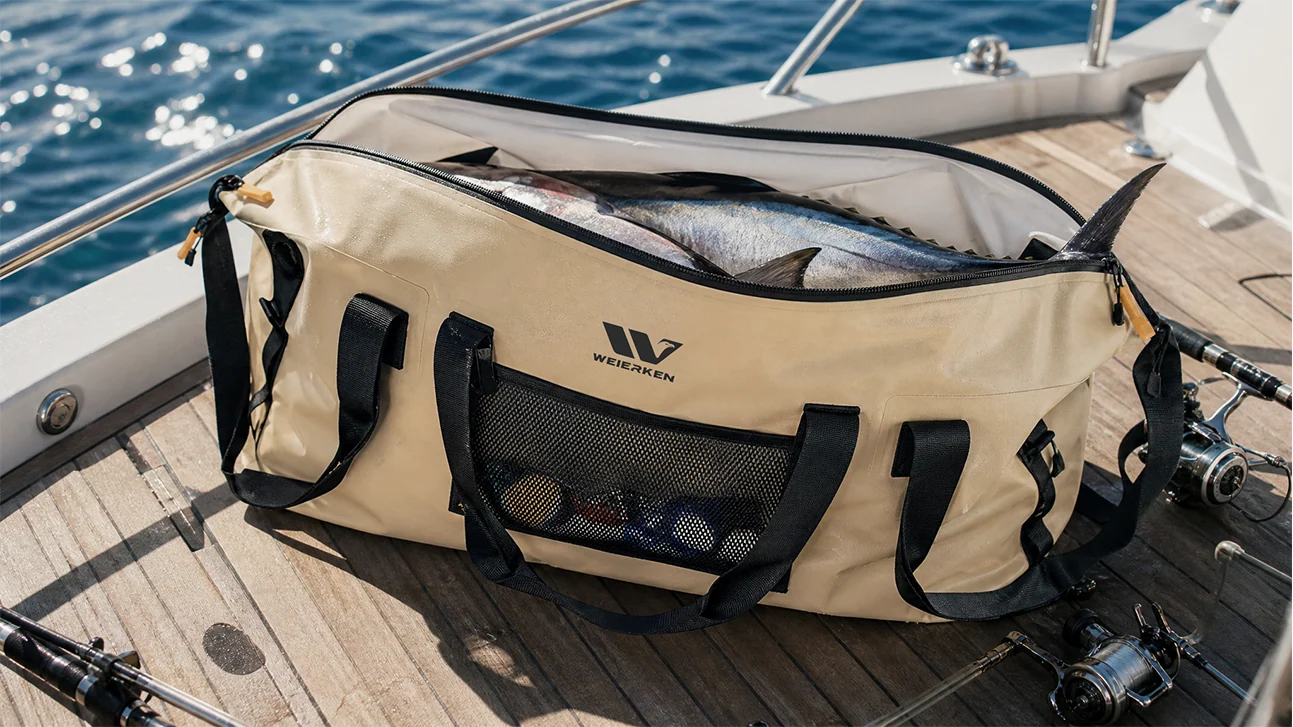
Fishing bags are handled with wet hands, placed on rough surfaces and opened while the user is moving or balancing. A good specification begins with that behavior rather than a list of generic pockets.
Map what needs fast access
Separate frequently used tackle, tools, phone and personal items from the main load. Consider whether a front pouch, landing-net holder, rod attachment or transparent window improves use without creating new snag points.
Balance protection and access
Roll-top and airtight closures improve protection but can slow one-hand access. Magnetic lids and quick-access panels are useful when the product brief allows a different protection level.
Review the carry system under load
Check shoulder-strap position, handle balance, waist support and interference with life jackets or other gear. Test the bag loaded, not empty.
Plan for salt, sand and cleaning
Hardware, zipper pulls, coatings and welded seams should be reviewed for the intended environment. Smooth internal surfaces, drainage and removable components can make maintenance easier.
Design around a real fishing routine
Start with the sequence of actions on the shore or boat: carrying equipment, putting the bag down, retrieving a frequently used item and repacking wet accessories. Ask which operations happen with one hand, gloves or limited space. The answers help determine opening direction, pocket position and whether loose straps become a nuisance.
Separate quick-access storage from the protected main compartment. A tool pocket, wet-accessory area and electronics space do not necessarily need the same construction. Mark the intended contents of each compartment on a sketch and identify any sharp edges that need protection. Do not describe the bag as a safety or flotation device without appropriate supporting evidence.
Use the intended containers and tackle boxes in the sample review. Photograph the bag packed, standing and being carried. Check whether external pockets become unusable once the main chamber is full and whether the shoulder strap obstructs the lid. A good flat drawing can still hide conflicts that appear under load.
Different routines suggest different review priorities
| Review area | What to define | Decision or evidence |
|---|---|---|
| Shore session | Walking distance and repeated access | Check carry comfort, stable placement and tool retrieval |
| Boat use | Limited deck space and moving surroundings | Review footprint, attachments and loose strap management |
| Wet equipment return | Damp accessories and cleaning | Review separation, access and drying instructions |
How should cleaning requirements enter the brief?
Describe likely dirt, moisture and the intended cleaning routine, then ask for care instructions compatible with the selected materials and hardware. Do not assume every laminate, trim or decoration tolerates the same treatment. Test the proposed routine on the assembled sample before finalising customer instructions.
For the next development decision, see our Waterproof Bag Pocket Layout: Separate Quick Access from Protected Storage.
From brief to sample
Build the right bag for your collection.
Share the intended use, product format, quantity and destination market. Weierken can review the construction and sampling requirements with your team.
Discuss your bag project Explore OEM & ODM